About Stylomecon heterophylla (Benth.) G.Taylor
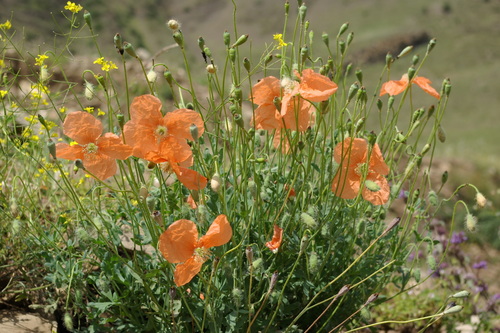
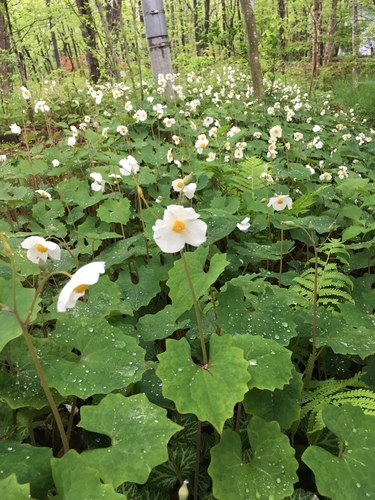
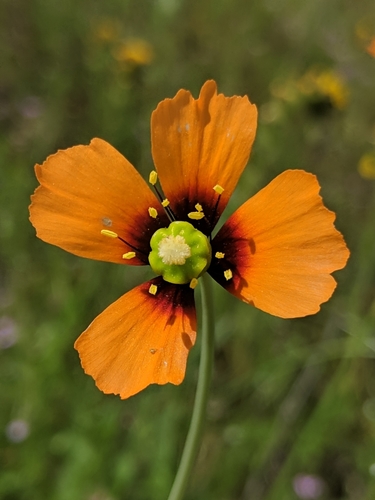
Commonly called the wind poppy, this species has the accepted scientific name Stylomecon heterophylla (Benth.) G.Taylor, and is also referenced as Papaver heterophyllum in botanical literature. It is a relatively short-lived annual herb. Morphologically, it produces radially symmetrical bright orange flowers on long, thin, wiry stems, and bears lobed leaves. Each flower has a purple-black central deep red disk that fades to this color distally at petal bases; its staminal filaments are dark red to black. Its blooming season runs from February to late May, with peak bloom occurring in March and April. This species is a polyploid, documented as an octoploid based on chromosome number studies. It is self-compatible and capable of autonomous self-pollination. This species is closely related to Papaver californicum, sharing many similar vegetative and reproductive traits. Ernst noted in 1962 that the seedling stages of the two species are identical, and even adult plants are so similar that identifications cannot be made without examining their gynoecia. The two species can be more reliably distinguished by differences in leaf, flower, and fruit morphology. Kadereit & Baldwin describe the gynoecium of this species as having a flat ovary roof, with capsules that dehisce through pores located under this roof. This species produces seeds with a mean length of 803 μm and a coarser surface texture, compared to the smaller seeds of P. californicum. For leaf morphology, this species has a delicate dissected pattern on its middle and distal cauline leaves. Its specific epithet heterophyllum is thought to derive from the observation of a distinctive sharp transition between the margins of proximal and middle cauline leaves. This plant is native to the coastal mountains ranging from central California down to Baja California, where it grows on slope sides below 1200 m (4000 feet) in elevation. It is most often found in chaparral, grasslands, and oak woodlands. It prefers low-moisture, well-drained soil in partial shade, and it is uncommon even within its native range. It tolerates a broader range of environmental conditions than P. californicum. Wind poppies are most often found growing wild, and they rarely set seed except after wildfires. Unlike many other poppy species used globally for medicinal purposes, the wind poppy is not farmed, not recognized for medicinal use, and not consumed by humans. However, wind poppy seeds are sold commercially, because the plant’s bright flower color and lily-like scent are considered horticulturally appealing.