About Struthiola striata Lam.
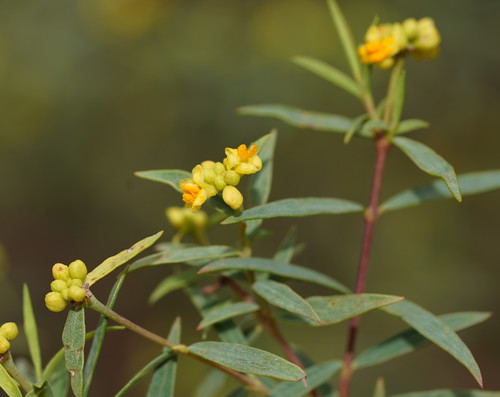
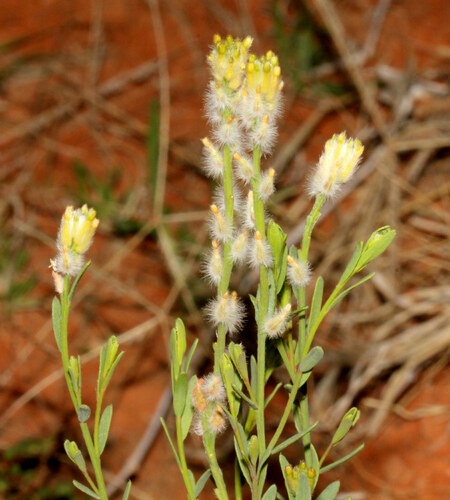
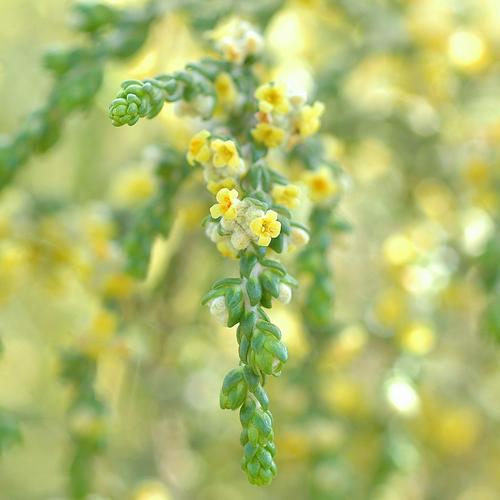
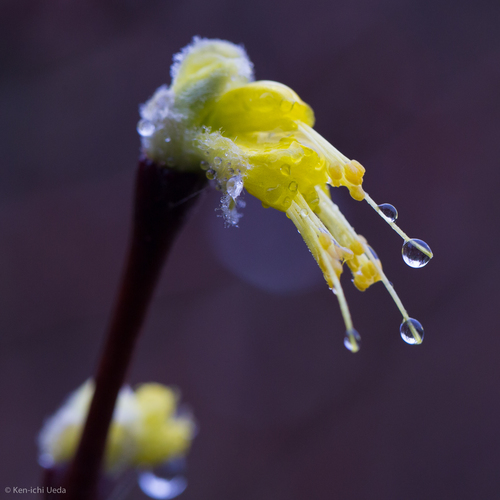
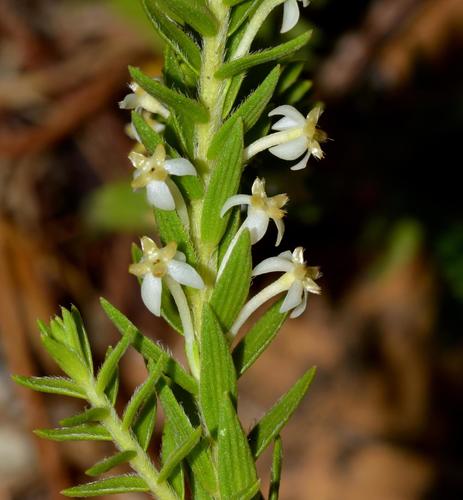
Struthiola striata Lam., commonly known as ribbed capespray, is a rounded shrub growing up to 1.5 m (4.9 ft) high, growing from a single trunk at ground level. Young branches are initially covered in soft, tightly pressed hairs, and become hairless as they age. The leaves are arranged in opposite pairs, are roughly upright, overlap each other, and their blades attach directly to branches with no leaf stalk. Leaves are oval to lance-shaped, 5–8.5 mm (0.20–0.33 in) long and 2–4 mm (0.079–0.157 in) wide, are slightly depressed along the midvein, end in a nearly pointed tip, and have a rim lined with a row of tightly pressed hairs. When young, 3 to 5 lengthwise stripes are visible on the outward-facing surface of the leaf. The sessile flowers grow in leaf axils along a substantial portion of the branch tip, forming an inflorescence called a spike. Two opposite awl-shaped bracteoles sit at the base of each flower, measuring about 2.5 mm (0.098 in) long, with a straight row of hairs along the margin and a blunt tip that ends in a tuft of hairs. The calyx is cream-colored; it has a cylindrical tube around 1 cm (0.39 in) long at its base, which is covered on the outside with soft, tightly pressed hairs. At the top of the calyx are 4 oval, elongated, nearly pointed lobes 1–2 mm (0.039–0.079 in) long and 1.5–2.5 mm (0.059–0.098 in) wide, which are hairless except for a tuft of hairs at the tips of the outer pair. Four yellow, elliptic, fleshy petal-like scales grow above the calyx lobes, alternating with them, and these scales are surrounded by stiff hairs that may be shorter or longer than the scales themselves. Approximately 1 mm (0.039 in) below the mouth of the calyx tube is one whorl of four sessile stamens, each with a reddish wart at the tip. The ovary is egg-shaped, hairless, and about 1 mm long; it is topped by a style around 8 mm (0.31 in) long that ends in a brush-like stigma. This species is restricted to the coast of the Western Cape province of South Africa, ranging from Yzerfontein in the north to Mossel Bay in the east. It grows in sand fynbos vegetation, found on lower slopes and coastal sand flats. It gives off a honey scent at night, and is pollinated by moths. It is classified as a species of least concern for conservation, as its populations remain stable.