About Stropharia hornemannii (Fr.) S.Lundell & Nannf.
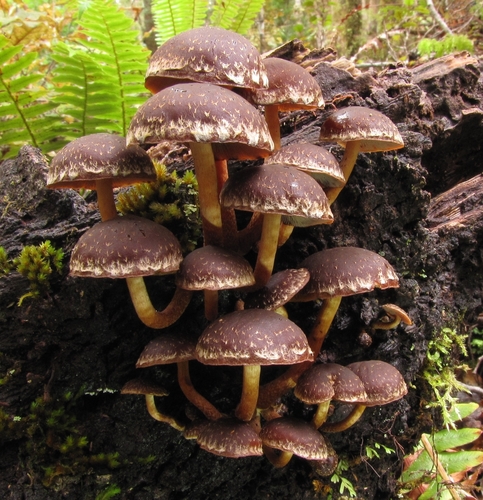
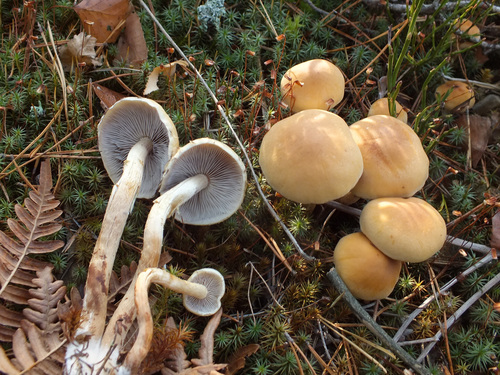
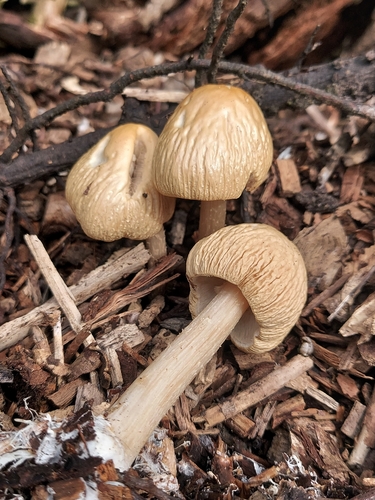
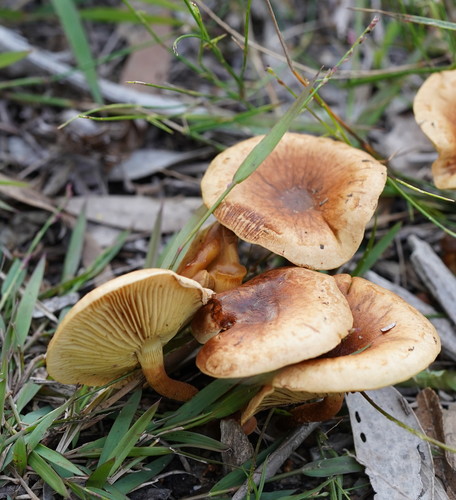
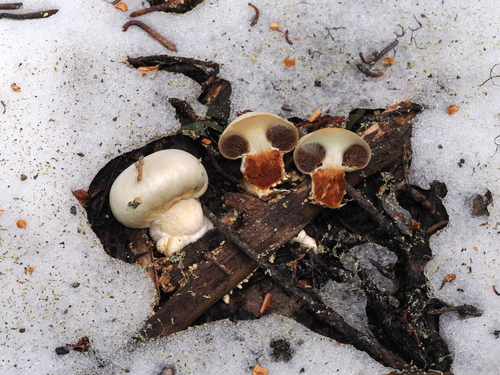
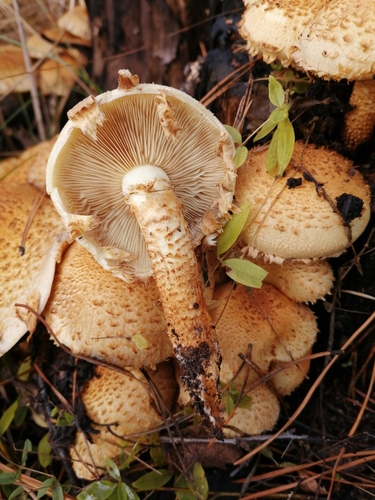
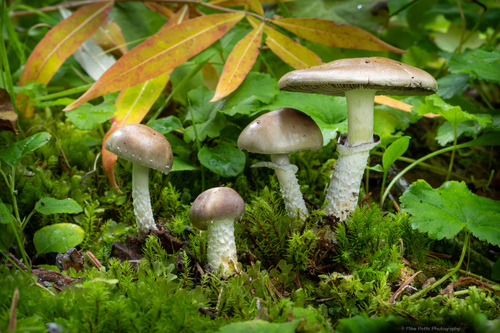
Stropharia hornemannii is a distinctive mushroom-forming fungus species in the genus Stropharia. Its fruiting body has a large cap that can reach up to 12 centimetres (4+3⁄4 inches) in diameter. Young caps are convex with an elevated centre and inflexed margin, becoming convex-expanded as they mature. Cap colour varies widely between specimens: it may be greyish-brown with purplish tints, reddish-brown at the centre and pale yellowish at the margins, or sometimes entirely yellowish. To the naked eye, the cap surface looks smooth, but brownish-purplish innate fibrils become visible under magnification. The cap feels moist to the touch and can become viscous, especially in young specimens. Young specimens have a well-developed whitish partial veil forming a membrane; fragments of this veil often stay attached to the cap edges as the cap expands. The stipe (stem) is 5–15 cm (2–6 in) long and 0.5–2.5 cm (1⁄4–1 in) thick, slender and yellowish-white, occasionally with brownish-yellow stains. A fragile, hanging, pleated-grooved ring sits on the upper portion of the stipe, though it may deteriorate with age. Below the ring, the stipe is covered with spreading whitish scales that can also disappear in mature specimens; above the ring, the stipe has a roughly powdered appearance. The gills (lamellae) are closely spaced, broadly attached to the stipe, and extend down the stipe in a thin line. Young gills are greyish-violet with amethyst tints, and later darken as spores develop. Under magnification, gill edges look whitish and fringed. When cut, the mushroom gives off a strong, unpleasant odour, though the odour is less noticeable on intact external tissue. Its taste is reported as unpleasant and bitter after chewing. Microscopically, the spores measure 11.5–13 × 6–6.5 μm, are elliptical with a distinct germination pore, and are produced on four-spored basidia. Numerous marginal hairs (cheilocystidia) are found on the gill edges, while variable-shaped chrysocystidia are present on the gill faces. The cap cuticle is made of slender, clamped hyphae with gelatinised walls, and the flesh contains oil-bearing hyphae that fragment into refractive yellow cylindrical bodies. This mushroom is inedible and may be poisonous. Stropharia hornemannii is primarily a boreal species with a distribution centred in Northern Europe, and is particularly common in Scandinavia. In his Monographia, Elias Magnus Fries described it as "ubiquitous in our coniferous forests on the ground, rarer on trunks, throughout autumn". The species has been recorded at multiple sites across Central Europe, with detailed occurrence records compiled by various mycologists. The first confirmed collection of the species in France was reported in 1971, from the Massif Central — this was the westernmost extension of its known range at the time. The 1971 find included over 50 fruiting bodies growing at several sites near Col de la Charme, around 1,200 metres altitude in the Bois Noirs region. The collection site was a gently sloping forest dominated by fir trees, where the fungus grew on decaying wood fragments buried in humus and moss (Rhytidiadelphus loreus). Stropharia hornemannii prefers coniferous woodland habitats, especially those dominated by fir species. It grows most often on the ground, but may occasionally grow directly on decaying wood. Its fruiting period lasts through the autumn, and confirmed collections from France are from September and October.