About Stropharia caerulea Kreisel
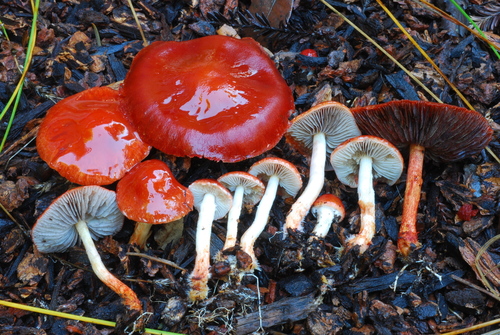
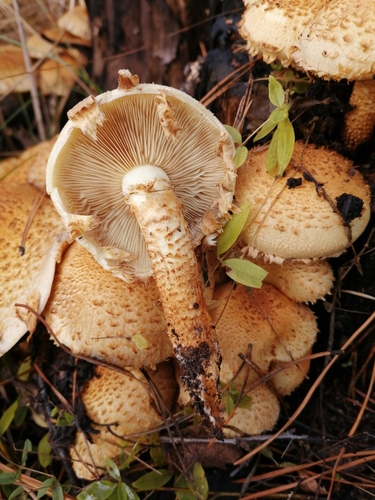
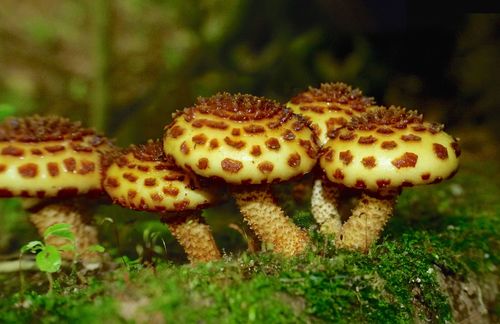
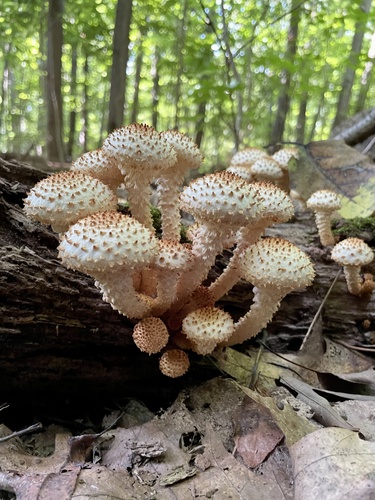
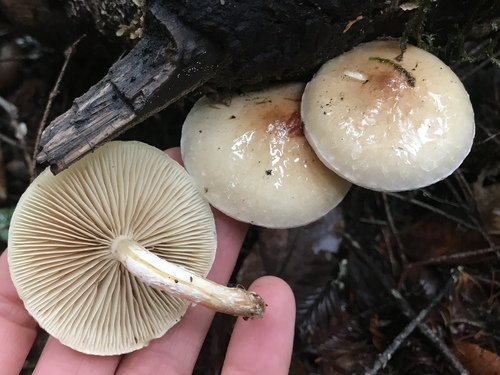
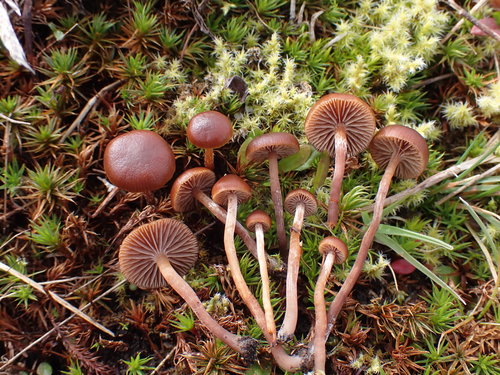
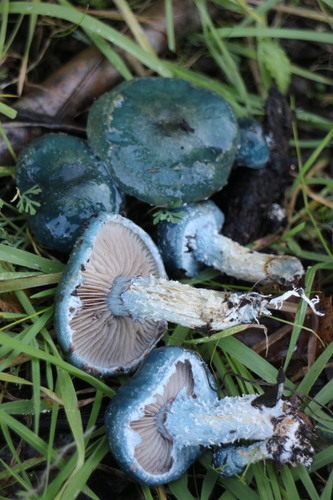
The fruitbodies of Stropharia caerulea have conical to flattened caps 2–7.5 cm (0.8–3.0 in) in diameter, and usually bear a low, broad umbo. Cap colour changes with age, ranging from pale blue-green to yellowish-bluish green. A whitish zone around the cap margin is common, and the margin always has bluish-green tints. When moist, the cap is sticky and its cuticle can be easily peeled; dry caps are smooth and shiny. Gills start pale purplish-brown and darken to brown as spores mature with age. They attach to the stipe in an adnate or sinuate pattern. The stipe has a short-lived annular ring zone; stipe tissue above this zone is smooth, while tissue below is fibrous and scaly. Flesh is colourless, though it may have blue tinges in the cap and stipe, and has no distinctive odour or flavour. The edibility of Stropharia caerulea (also referred to as Stropharia cyanea) fruit bodies is unknown. The spore print is brown. Spores typically measure 8.0–9.0 by 4.0–5.5 μm, and range in shape from ellipsoid to oblong to ovoid depending on viewing angle. Four-spored, narrowly club-shaped basidia (spore-bearing cells) measure 24–40 by 7–12 μm. Club-shaped cheilochrysocystidia on the gill edge measure 30–55 by 4–40 μm, with a 2–5 μm wide neck. Pleurochrysocystidia on the gill face measure 40–60 by 5–18 μm, with a 2–4 μm wide neck. Clamp connections are abundant in all tissues of S. caerulea. This fungus produces acanthocytes, which are spiny cells formed on short branches of the mycelium. Stropharia caerulea is a saprophytic fungus that produces fruit singly or in groups. It grows in and on meadows, roadsides, hedgerows, gardens, and woodchip mulch. In Europe, it is often found in beech woods growing in alkaline soil. It is a common species distributed across Europe, where it fruits from July to November. While it also occurs in North America, where it generally fruits from August to October, the full extent of its distribution on the continent is not known. S. caerulea fruitbodies form mycelial cords: rootlike structures made of a dense mass of hyphae that create extensive underground networks. These networks transport nutrients and let the fungus forage for resources. The cords are often associated with stems and rhizomes of the common nettle Urtica dioica. Researchers have studied the development of this species' mycelial systems and its interactions with other cord-forming wood decomposer basidiomycetes. The mycelia of Stropharia caerulea form a fractal structure with a dense, relatively slowly extending front, a form adapted for finding relatively homogeneously distributed nutrients, which corresponds to short-range foraging. Increased soil nitrogen or phosphorus supply increases the fractal branching of the mycelia, which supports increased nutrient uptake.