About Stropharia ambigua (Peck) Zeller
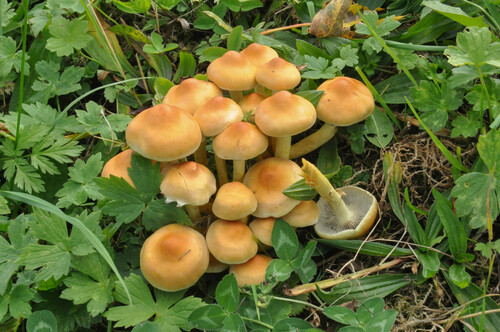
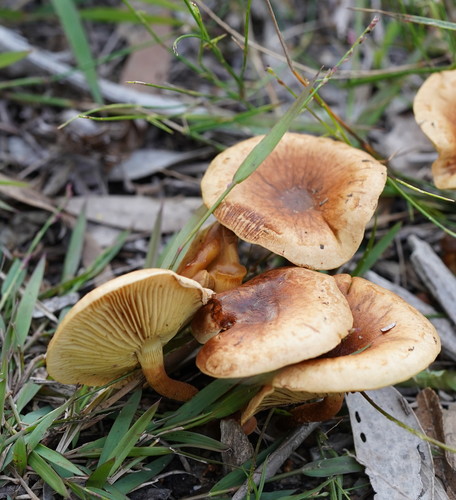
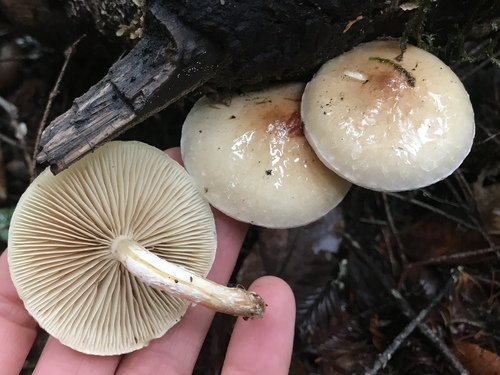
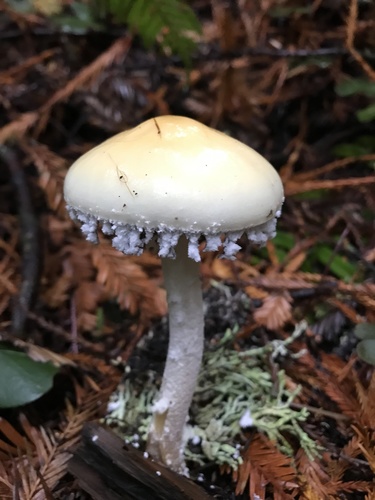
The cap of Stropharia ambigua is 3 to 15 cm (1+1⁄4 to 6 inches) broad, starting obtuse to convex, and becoming flat or uplifted with age. It has a smooth surface, is slimy when moist, and is yellowish; fragments of the white partial veil may hang from the cap margin. The flesh is white, thick, and soft. The gills start pale gray and gradually darken to purplish-gray or purplish-black, and they occasionally separate from the stipe as they age. The stipe is 6 to 18 cm (2+1⁄4 to 7 inches) long, 1–2 cm wide, and is either stuffed or hollow. Bits of white veil may hang from the stipe, and less commonly it bears a brittle ring. The partial veil is soft and white, and the species has no volva. The spore print is dark purplish to nearly black. Fruiting occurs in the spring and fall, and the species has been described as tasting like old leaves. In distribution and habitat, Stropharia ambigua appears in late fall, growing solitary, scattered, or in groups on rich humus, most often under conifers. It can also be found growing with alder and other hardwoods along the Pacific Coast. It is frequently found in disturbed areas, such as sites where wood has been handled. It will colonize outdoor mushroom beds after wood chips have been decomposed by a primary saprotroph, and it favors cold, damp environments.