About Stropharia aeruginosa (Curtis) Quél.
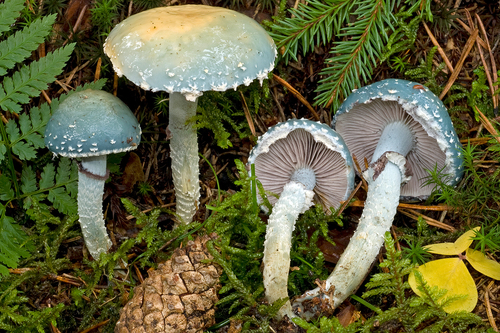
Stropharia aeruginosa, commonly known as the verdigris agaric, has a cap that starts convex, broadens with age, and eventually becomes umbonate. The cap measures 2 to 8 centimetres (3⁄4 to 3+1⁄4 inches) wide. When young, the cap is vivid blue-green, very glutinous (slimy), and has scattered white veil remnants along its edge. The pigment in the cap’s slime fades or washes off as the mushroom matures, turning the cap yellow ocher; this color change often appears in patches, and is most prominent at the cap’s centre. Eventually, the cap will lose all of its original blue-green colouring. The stem is white, fairly long, uniform in thickness, and bears a fragile brown-black ring. Below the ring, the stem is covered in fine white scales or flakes. The gills start white, then mature to clay-brown, and sometimes have white edges. This species produces a brownish-purple spore print; its oval spores measure 7–10 x 5 μm. The mushroom is common across Europe (including Britain), Asia (Iran), and parts of North America. It grows on rotting wood, found in grassy woodlands and on roadside verges, and favours wood-chip mulches in gardens and parks in particular. Many guidebooks published in the Western Hemisphere list Stropharia aeruginosa as poisonous, though the effects of poisoning and its toxic constituents remain unclear. Some European guidebooks classify it as edible, but many find it undesirable due to its mildly spicy taste.