About Strobilurus tenacellus (Pers.) Singer
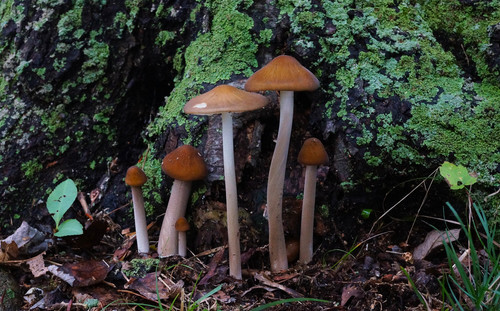
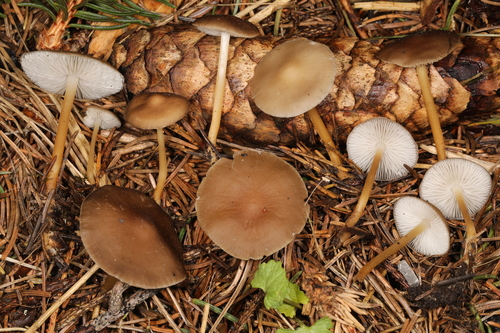
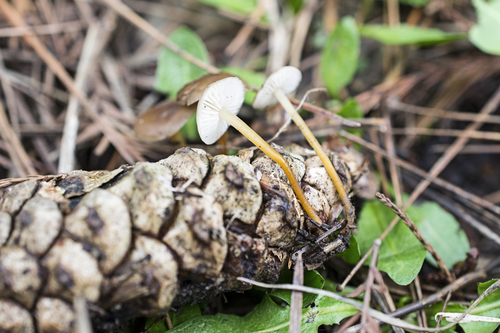
Strobilurus tenacellus (Pers.) Singer has a cap that starts convex, then flattens; it may keep a small central papilla, or develop a central depression. Caps reach 5–15 mm (0.2–0.6 in) in diameter. The smooth cap is hygrophanous, meaning it changes colour as it loses or absorbs moisture, and has shallow radial grooves that extend roughly halfway up the cap surface. Cap colour ranges from reddish to brownish, and the centre is often paler than the margin; the colour fades to greyish when dry. Greyish-white gills attach to the cap either freely or with a deep, notched emarginate attachment. Gills are somewhat crowded, with 20–25 full gills per side, plus 1 to 7 tiers of short, interspersed lamellulae that do not reach all the way from the cap margin to the stipe. The cylindrical stipe is 4–7.5 cm (1.6–3.0 in) long and 0.5–2 mm thick, with a root-like pseudorrhiza at its base that extends into the growing substrate. The upper portion of the stipe is yellowish brown, while the lower portion is dark orange-brown to reddish brown. The flesh has no odour and usually tastes bitter. Though fruit bodies are sometimes listed as edible, they are too small to have any culinary value. The spore print of this species is white. Spores are roughly elliptical to tear-shaped, measuring 5.0–7.5 by 2.4–4.0 μm. Four-spored spore-bearing basidia measure 20–40 by 7–11 μm. Thin-walled cheilocystidia, cystidia located on the gill edge, are plentiful, spindle-shaped to somewhat flask-shaped with a sharp tip, and measure 30–70 by 3–10 μm. Pleurocystidia, located on the gill face, are similar in shape and size to cheilocystidia, though they are usually less numerous. The cap cuticle is a hymeniderm made of club-shaped to somewhat spherical cells 8–25 by 7–20 μm, mixed with flask-shaped pileocystidia, cystidia on the cap, that measure 20–45 by 5–11 μm. Hyphae of this species do not have clamp connections. Strobilurus tenacellus is a saprobic wood-rotting fungus. It fruits singly or in small groups on fallen, often partially buried cones of Scots pine (Pinus sylvestris), European black pine (Pinus nigra), and sometimes spruce (Picea), growing in coniferous and mixed forests. It occurs in Europe and Asia, with recorded observations in Japan and Jordan. In Europe, it typically fruits between March and June. Occurrences of the species are occasional.