About Strobilomyces strobilaceus (Scop.) Berk.
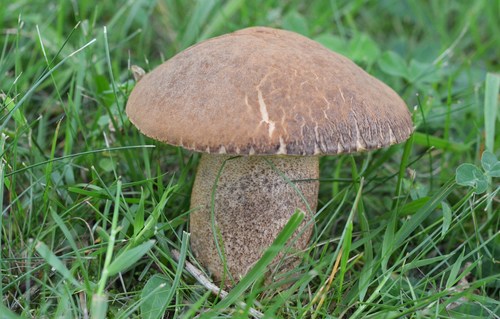
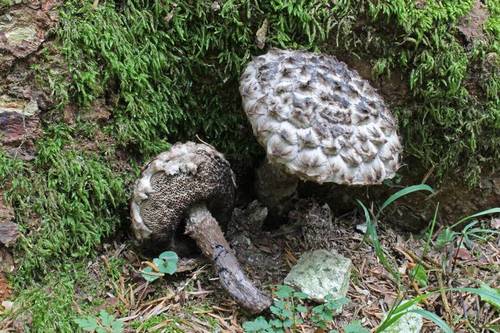
The fruit bodies of Strobilomyces strobilaceus have caps between 4 and 11 cm (1+1⁄2 and 4+1⁄4 inches) wide, with a convex shape and a villous, involute margin. The cap surface is covered with tuft-like, dark grey to brown erect scales. The stipe grows up to 14 cm (5+1⁄2 inches) long and 2 cm (3⁄4 inch) thick. It shares the same colouring as the cap, has a woolly surface, and features either a thick, ascending annulus, or only coloured bands left by the partial veil. The pores on the underside of the cap are angular, light grey, and turn blackish as the mushroom ages. The flesh is thick and initially white, but develops pink stains that later turn blackish. The dark brown to black spores are 9–15 by 8–12 μm, short elliptic, and covered with a mesh-like ornament. The spore print produced by this species is blackish. Strobilomyces strobilaceus grows either solitary or in groups in deciduous and coniferous forests, found in low mountain ranges and alpine areas of eastern North America, Europe, and Asia, specifically in Iran and Taiwan. It is less common in lowlands. The fungus fruit bodies appear between July and October growing under oak and beech trees. Young specimens of this species are edible, with a choice flavour.