About Strix woodfordii (A.Smith, 1834)
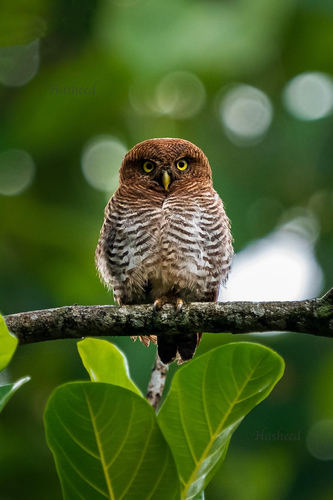
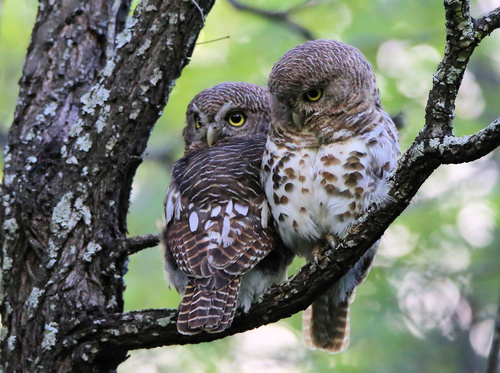
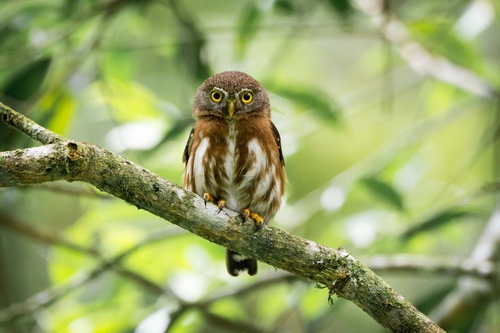
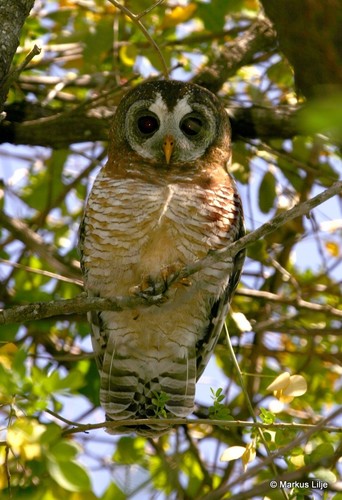
The African wood owl, scientifically named Strix woodfordii (A.Smith, 1834), is a medium-sized owl. It has the characteristic rounded head of the genus Strix, similar to the Palearctic tawny owl or Holarctic great grey owl, with large dark eyes bordered by white eyebrows. The remainder of the head is generally dark brown with white spots, and it has a prominent yellow beak. Its belly is white with brown barring, and it has an overall rich brown plumage with paler underparts, though this plumage pattern varies considerably across the species' range. Juvenile African wood owls are a paler rufous colour. This owl measures 30.5 to 35 cm (12.0 to 13.8 in) in length and weighs 240 to 350 grams (8.5 to 12.3 oz).
African wood owls are distributed across much of sub-Saharan Africa. Their range extends from Senegal and The Gambia, along the Gulf of Guinea into the Congo Basin and Angola. In the eastern part of the continent, they occur from Ethiopia down through Kenya and Tanzania into Zambia and Mozambique. While they are absent from most of Namibia, they are found in the Caprivi region, and also occur in Botswana, Zimbabwe, Eswatini and South Africa as far south as Cape Town.
The species inhabits indigenous forests and woodlands of sub-Saharan Africa, and is occasionally found in plantations. In Southern Africa, it lives in riparian, coastal and escarpment forests, and can also be found in well-wooded suburban areas. African wood owls are strictly nocturnal. They eat mostly insects, but will also take reptiles, small mammals, and other birds; most prey is caught by swooping from a perch.