About Strix varia Barton, 1799
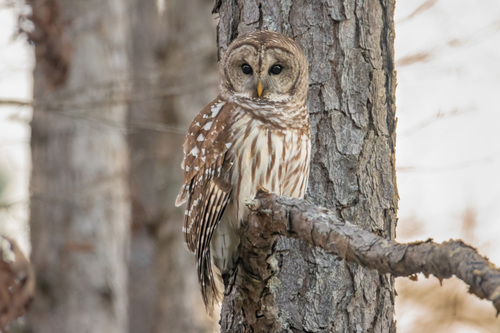
The barred owl (Strix varia Barton, 1799) has a subdued coloration compared to some other sympatric owls. It is overall greyish - brown or brown, with the brown color extending from the head to the back. The mantle and back are scalloped with white bars, and the wing coverts have whitish spotting. The underside has a pale creamy gray - brown base color, with horizontal barring on the throat and upper chest and vertical streaking on the belly. The head is large and rounded without ear tufts, and the facial disc has pale grayish - brown with darker concentric lines. The bill is pale straw - yellow, and the cere is 'horn - colored'. The eyes are dark brown, closely set, and have well - developed anatomy, with a large number of rod cells in the sensitive retina and a relatively small pecten oculi. Its vision in low light is similar to that of other owls. The tarsi and toes are feathered up to the dark gray, black - tipped talons, and the flight feathers and tail are barred. Young barred owls are first fluffy brownish - white and then become juveniles resembling adults but with less distinct markings. They obtain full adult plumage after about a year. Southern barred owls are darker and slightly smaller, and rare albino individuals are pure white with brown eyes.
The barred owl is a large species, measuring 40 to 63 cm in length and having a wingspan of 96 to 125 cm. The female is larger than the male, and there are differences in standard measurements between the sexes. Sexual dimorphism is especially pronounced in body mass, with males sometimes a third lighter. The wing - loading is high, and like most owls, their flight is silent due to the soft and comb - like wing feathers.
The barred owl is native to most of the eastern United States and much of southern Canada. It has expanded its range in the last century, moving westward due to increased forest cover. The expansion was facilitated by European - American settlers' actions such as wildfire suppression and tree - planting. It now ranges through parts of western Canada and the western United States.
The barred owl prefers old deciduous, mixed, or occasionally coniferous forests, especially old - growth forests for their nest sites and hunting advantages. It can also be found in semi - open wooded areas, suburban neighborhoods, and areas with some water. However, its habitat preferences vary by region.
The preferred nest site is a hollow trunk or broken - off snag of a large tree, usually in deep, dark wooded areas near water. The average nest height is 6.8 to 13.4 m above the ground. The species may also use other birds' nests or squirrel dreys in areas with few natural hollows. Suitable nesting hollows can be reused for many years.
Barred owls usually pair - bond for life. Courtship involves male displays and duets. Copulation occurs in late winter, and egg - laying usually starts in March, with intervals of two to three days between eggs. The female lays 2 to 3 eggs (up to 5 is possible). The eggs are pure white, oval, and the female incubates them for about 28 days while the male provides food. Both parents hunt for the young until they can fly well at about 6 weeks. The young are altricial and go through different stages of feather development, fledging at about 36 - 39 days. They gain independence in early to mid - autumn. The age of maturity is around two years, and breeding success varies by region and is influenced by factors like nest - site quality, food supply, and disturbance levels.