About Strix seloputo Horsfield, 1821
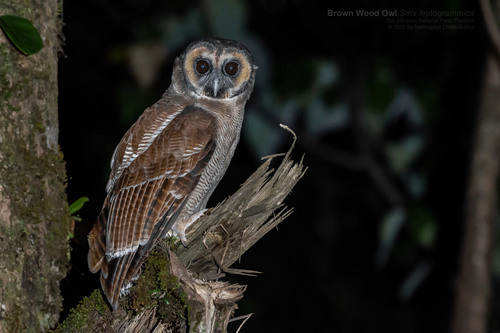
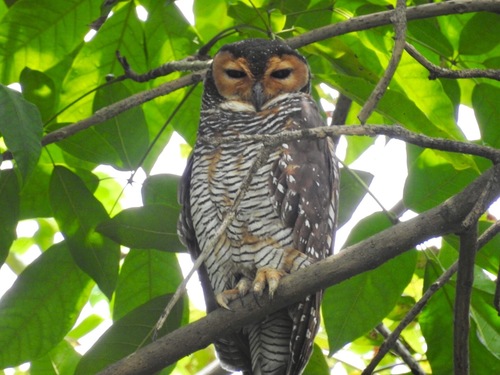
Strix seloputo Horsfield, 1821, commonly known as the spotted wood owl, reaches an adult body length of roughly 44 to 48 centimeters (17 to 19 inches), with a wing length between 30 and 36 centimeters (12 to 14 inches). It has a chocolate brown head, an orangish-buff facial disc, and no ear-tufts; the nominate subspecies additionally has a yellowish throat band. Its upper body is coffee-colored, marked with white bars and spots that have black edges. The underparts are dull yellow, patterned with broad white bars and narrow black bars. This owl has dark brown eyes, a greenish-black beak, fully feathered legs and toes, and olive coloration on any exposed portions of the legs and toes. Its call is a rolling "huhuhu" followed by a long "whoo". Three currently recognized subspecies exist with distinct ranges. The nominate subspecies, S. s. seloputo, is found from southern Myanmar and central Thailand down to Singapore, as well as in Jambi (Sumatra) and Java. S. s. baweana is endemic only to Bawean Island, located off the north coast of Java. S. s. wiepkini is found in the Calamian Islands and Palawan in the Philippines. Typical habitats for this species include lowland forest, mangrove swamps, cleared woodland, plantations, and parks located within towns and villages. The spotted wood owl's diet is primarily made up of mice and rats, with insects and small birds eaten as supplementary prey.