About Strix ocellata (R.Lesson, 1839)
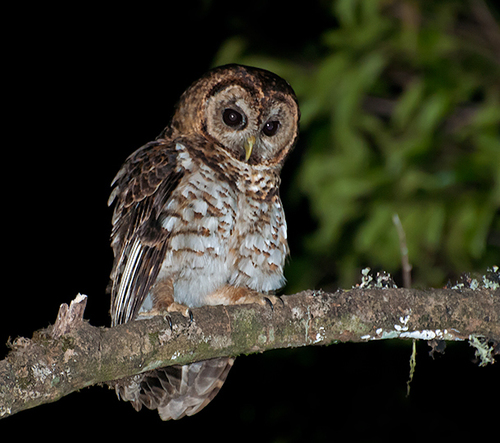
This large owl, Strix ocellata, lacks ear tufts, and has mottled and vermiculated plumage in reddish brown and white. Its facial disc features fine concentric black and white barring. Males and females look identical. The owl has a white chin, orange eyelids, and dark brown irises. Its tail is narrowly barred with brown and black. The concentric facial barring and mottled crown distinguish this species from the brown wood owl found in southern India. Three subspecies of Strix ocellata are currently recognized, with no sharp boundaries between their distributions. The nominate subspecies, S. o. ocellata (Lesson, 1839), occurs in southern India, and males of this subspecies have shorter wings, measuring 333–338 mm, than males of S. o. grandis. S. o. grisescens Koelz, 1950 is found in northern India south of the Himalayas, ranging west to Pakistan and east to Bihar. Individuals of this subspecies have paler upper markings, and male wing length ranges from 338–346 mm. S. o. grandis Koelz, 1950 originates from Gujarat, and is distinguished by a male wing length of 360–372 mm. Strix ocellata occurs in plains regions, inhabiting gardens and lightly wooded areas. The owls roost in trees during the day, selecting branches with dense foliage. While there is an old museum specimen of this species collected from Lahore, there have been no recent records of it in Pakistan. The species’ range extends east to West Bengal, and it can be observed across many parts of India. These owls roost during the day, usually in pairs. When disturbed, they may fly in bright sunshine, though they prefer to take shelter in a dense tree grove. They produce an eerie chuhua-aa call, with a quaver on the second note. This call is an antiphonal duet performed by a mated male and female: the male calls one or two times, followed by the female’s shorter, less tremulous version of the call. Calling is most frequent in November, when the owls begin their breeding season. Most nests are found between February and April. The species also produces a single-note hoot and a screech similar to that of the barn owl. Nests are located in tree hollows, where two to three white eggs are laid. Strix ocellata feeds on palm squirrels, mice, and other small mammals.