About Strix nivicolum (Blyth, 1845)
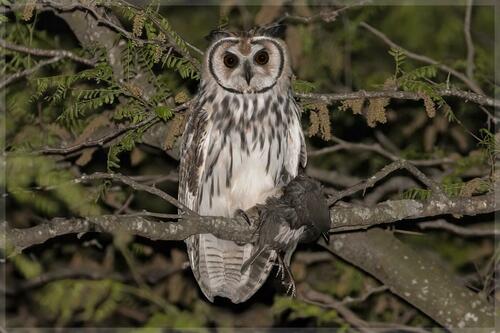
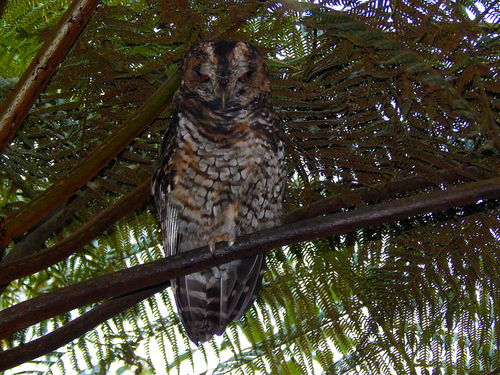
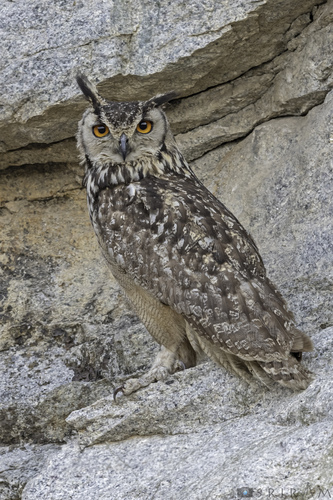
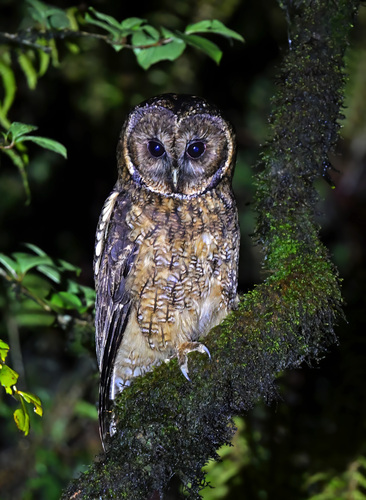
Strix nivicolum, commonly known as the Himalayan owl, is a medium-sized owl species. It measures 35–40 cm in length with an approximate wingspan of 270 mm. Its plumage is warm-toned and tawny-colored, with patches of light brown, dark brown, and white across the body. The chest is light brown and white, marked with vertical dark brown stripes. The wings and tail feathers are darker, with white horizontal bands and light patches near their tips. The Himalayan owl has a round, dark brown head with lighter speckling, and it does not have ear tufts, a pattern matching that of its wings. It has a small, hooked yellow beak that sits about half an inch below its eyes, in the center of its paler facial area. Unlike many bird species, male and female Himalayan owls are morphologically similar, and cannot be told apart by appearance. Juvenile Himalayan owls look similar to adults, but can be distinguished by faint white barring on the dark crown of their head. The Himalayan owl has a widespread range across East Asia and the Himalayas. Its distribution and habitat generally stay stationary year-round, though the species has been observed moving down to lower elevations during the winter. The species is split into three subspecies, each occupying different regions of Asia, but all share the same consistent habitat types: coniferous and oak forests, as well as rocky ravines in the Himalayan mountains. While the Himalayan owl is not considered broadly at risk of extinction, its habitat in some regions such as South Korea is increasingly threatened by deforestation and artificial filling of tree cavities. Tree cavities are the species' preferred breeding sites, and are critical to their reproduction and survival. In areas with reduced tree density and fewer natural tree cavities, Himalayan owls are known to use man-made nest boxes instead. Himalayan owl population levels and breeding success are highly dependent on habitat quality, and the species requires tree cavities or rock crevices to breed. The owls nest inside these holes and crevices from late winter through spring. In suitable habitat, breeding females typically find a nesting site and stay nearby until they are approached by a potential mate. After copulation, both the male and female build the nest in preparation for egg laying, which happens around one month later. After an average clutch of 3 eggs is laid, the owls change their flight behavior when entering the nest: they descend more slowly and spread their wings wider. This change in behavior is thought to prevent damage to the eggs. During incubation, males help the breeding effort by bringing food to nesting females and taking turns incubating the eggs. The eggs hatch roughly one month after they are laid. Both parents share the responsibility of caring for hatchlings, staying with the young almost constantly until approximately 17 days after hatching. At this point, parents begin roosting on nearby trees between feeding trips. By about 28 days after hatching, the fledglings are able to leave the nest.