About Strix nigrolineata (P.L.Sclater, 1859)
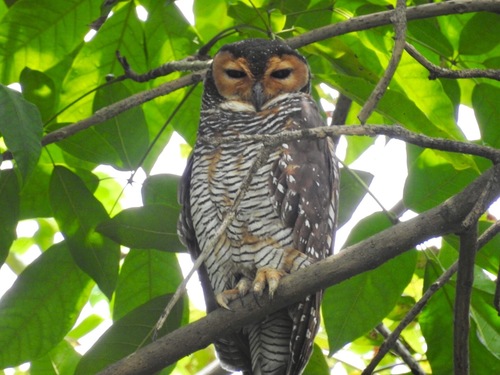
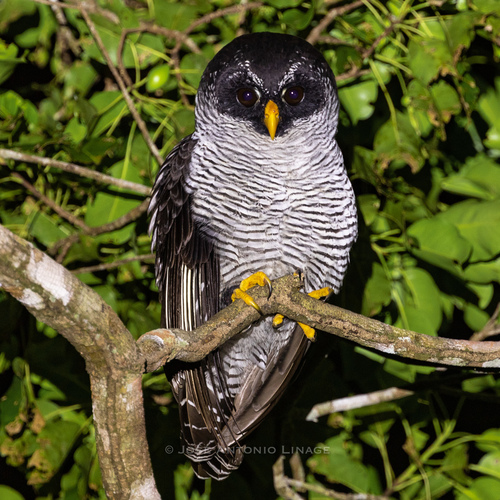
The black-and-white owl, scientifically named Strix nigrolineata (P.L.Sclater, 1859), is a medium-sized owl with a round head and no ear tufts. It measures 35 to 40 cm in length and weighs 400 to 535 grams. Like most owl species, females are typically larger than males, with average weights of 487 g for females and 418 g for males. Its breast, belly, and vent feature black-and-white striping. Apart from a black-and-white striped collar, its upperparts, from the crown to the tail, are sooty black. The facial disc is mostly sooty black, with white "eyebrows" that stretch from the bill to the collar. The beak is yellow-orange, and the eyes are reddish brown. Newly hatched chicks are covered in downy white plumage. Juveniles have a whitish face, dark brown upperparts, and a black underside barred with white. The black-and-white owl occurs mainly in gallery forests and rainforests, and can also be found in wet deciduous forests and mangrove forests, most often at altitudes ranging from sea level to 2400 meters. The species regularly visits small ponds while hunting. It typically nests in the foliage of large, tall trees such as mahogany, and it readily lives near areas of human habitation. Its distribution ranges from central Mexico south to northwestern Peru and western Colombia. It shares part of this range with the closely related mottled owl (Strix virgata). It can be found across 12 countries: Belize, Colombia, Costa Rica, Ecuador, El Salvador, Guatemala, Honduras, Mexico, Nicaragua, Panama, Peru, and Venezuela. This bird of prey is non-migratory, and remains in its range year-round. Breeding season begins in March. A monogamous pair forms after the male successfully courts the female with wing flaps and elaborate acrobatic flight. Before heavy downpours start, the pair settles on an isolated tree to protect their offspring from climbing predators, and they build their nest using epiphytes and flower structures such as orchids. While the female incubates a clutch of one or two eggs, the male forages to feed the pair and aggressively defends the nest, even from nearby humans. When the female is not incubating, she will sometimes accompany the male on foraging trips. The eggs are dull whitish, and weigh around 33.8 g on average—usually 6% of the female's body mass. Their average length is 46.4 mm (1.83 in), and average width is 38.4 mm (1.51 in). The black-and-white owl is one of the few owl species that sometimes lays only a single egg; this follows the trend of decreasing clutch size as species live closer to the Equator, and accounts for the species' low reproductive success. After an incubation period of at least 30 days, chicks hatch in April. Newly hatched chicks have white down, pink feet, and a pink beak, and weigh around 28 g two days after hatching. Chicks open their eyes for the first time at 14 days old, when black bars on their wings begin to develop. Chicks have a low survival rate, because they are preyed on by tayras, ocelots, coatis, falcons, and hawks.