About Strix leptogrammica Temminck, 1832
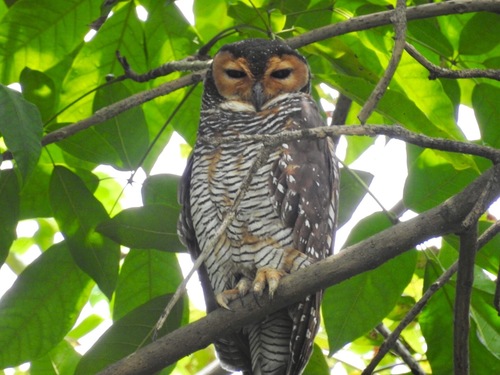
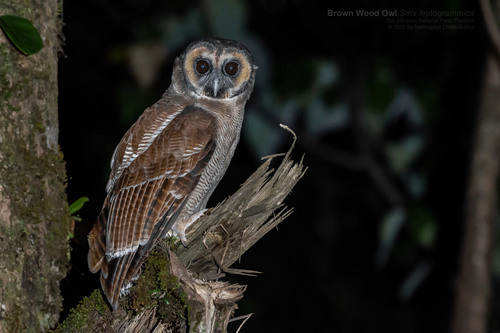
The brown wood owl, with the scientific name Strix leptogrammica, is distributed across India, Bangladesh, Sri Lanka, Indonesia, Taiwan, and southern China. It is a resident breeding species native to South Asia. This owl belongs to Strigidae, the family of typical owls that includes the majority of modern owl species, and is classified in the earless owl genus Strix. Brown wood owls are medium-large in size, measuring between 45 and 57 centimeters in length. Their upperparts are uniformly dark brown, with faint white spotting on the shoulders. Their underparts are buff-colored with brown streaking. The facial disc of the species is brown or rufous, edged with white and lacking concentric barring, and their eyes are dark brown. A distinct white neckband is present, and males and females have similar appearances. The common calls of the brown wood owl include a sequence (hoo) hoo hoo HOO, a deep goke-goke-ga-LOOO, or a loud scream. Its alarm call is a barking wow-wow. Some currently recognized subspecies have distinct vocalizations, differ in appearance, and are parapatric, so these groups may actually be separate species. The northern Strix leptogrammica newarensis group, commonly called the Himalayan wood-owl, includes the current subspecies newarensis, ticehursti, laotiana, and caligata. This group ranges from the Himalayan foothills of Kashmir eastward to Taiwan, and produces a soft low to-hooh call similar to the cooing of a rock dove. S. l. bartelsi, also known as Bartels's wood-owl or Javan wood-owl, is the southeasternmost taxon found on Java. It produces a loud, forceful single HOOH! call with long pauses between each call. The brown wood owl is highly nocturnal, and is most commonly found in dense forests. Small birds often mob the owl while it roosts in a tree, making this species easy to locate. Its diet consists mainly of small mammals, birds, and reptiles.