About Strix huhula Daudin, 1800
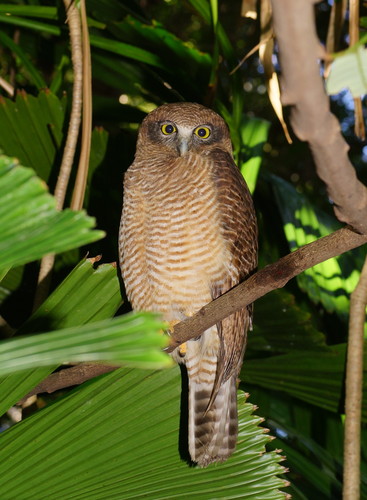
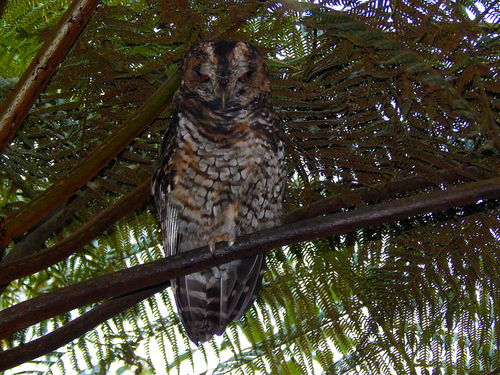
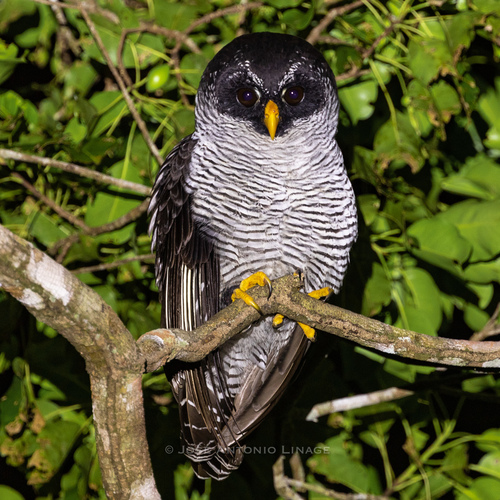
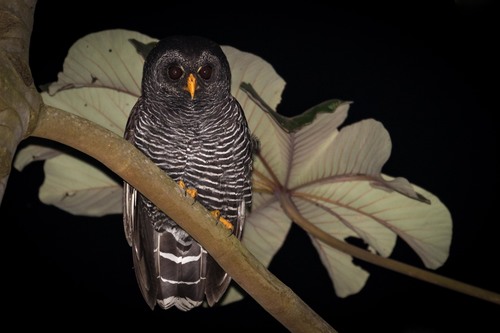
The black-banded owl (scientific name: Strix huhula Daudin, 1800) is a medium-sized owl, measuring 30–36 cm (12–14 in) in length. Its entire body is blackish with dense horizontal wavy white bars. A black facial mask surrounds its eyes. It has a rounded head with no ear tufts, and yellow-orange beak and feet. Its tail is sooty-brown with 4 to 5 narrow white bars plus a white terminal band. Its primary flight feathers are noticeably darker than the rest of its plumage. Black bristles and feathers grow around the beak, and extend along the leg down to the base of the toes. Black-banded owls are mostly found at elevations below 500 m (2,000 ft), with rare records of individuals at elevations as high as 1,400 m (5,000 ft). They live in various types of forests across South America, mainly tropical and subtropical forests. In Ecuador, they have been recorded almost exclusively in humid forests of the northeast. They have also been found in Atlantic forest, igapó forest, and terra-firme forest in Brazil, as well as Araucaria forests. They can also live in man-made or disturbed habitats including clearings, agricultural land and suburban areas. The black-banded owl is hard to detect, and is one of the least understood species of Strigidae in South America. Its population size has not been assessed, but it is described as relatively common despite being patchily distributed. While few sightings have been recorded, its range is believed to extend from southern Colombia to southeastern Argentina and Brazil. The difficulty of detecting this species is clearly illustrated by multiple records: the subspecies S. h. albomarginata has only been found a handful of times in recent years in the Atlantic forests of Brazil and Paraguay, and had only been recorded twice in Ecuador's Podocarpus National Park by 2012; in Minas Gerais, Brazil, the second recorded sighting happened 170 years after the first record of the species in the region; similarly, only unconfirmed historical records existed for Paraguay before 1995; the species was also found to be the least abundant large owl in Argentina's Misiones Province. Little is known about the reproduction of black-banded owls. The first description of their nesting was reported in 2013. According to the report, during the September to November incubation period, the egg was incubated all day and almost all night, and was only left alone for short 5–10 minute periods. This behavior was observed for at least three weeks after hatching. It is assumed that the female handles all incubation and brooding, which matches what has been observed in all other studied owl species. Both parent owls actively defend their nest, and the breeding pair most likely drives other owl species away from the center of their territory. Similar to other Ciccaba and Strix owls, the black-banded owl typically has a clutch size that results in one nestling. Its nest is built in forked branches rather than inside tree cavities. Black-banded owls may reuse the same tree fork for nesting in future years, but they do not necessarily breed in consecutive years.