About Strix aluco Linnaeus, 1758
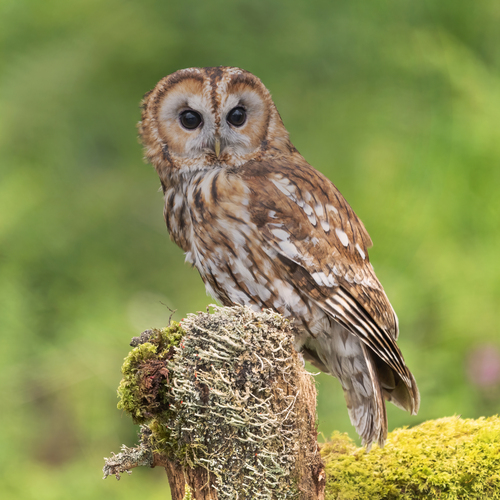
This is the description of Strix aluco Linnaeus, 1758, commonly known as the tawny owl. The tawny owl is a robust bird, measuring 37–46 cm (15–18 in) in length, with an 81–105 cm (32–41 in) wingspan. Its weight ranges from 385 to 800 g (0.849 to 1.764 lb). It has a large rounded head that lacks ear tufts, and the facial disc surrounding its dark brown eyes is usually quite plain. The nominate race has two plumage colour morphs: one with rufous brown upperparts, and another with greyish brown upperparts, with intermediate forms also occurring. Underparts of both morphs are whitish and streaked with brown. Feathers are moulted gradually between June and December. This species is sexually dimorphic: the female is much larger than the male, 5% longer and more than 25% heavier. The tawny owl flies with long glides on rounded wings, with less undulation and fewer wingbeats than other Eurasian owls, and typically flies at a greater height. Its flight is rather heavy and slow, particularly at takeoff, though it can reach a top flight speed of around 50 mph. Like most owls, its flight is silent, thanks to its feathers' soft, furry upper surfaces and a fringe on the leading edge of the outer primaries. Its size, squat shape and broad wings distinguish it from other owls within its range; the great grey owl (Strix nebulosa), Eurasian eagle-owl (Bubo bubo) and Ural owl (Strix uralensis) share a similar shape, but are much larger. An owl's eyes are positioned at the front of the head, with a field overlap of 50–70%, giving it better binocular vision than diurnal birds of prey, which have a field overlap of 30–50%. The tawny owl's retina holds about 56,000 light-sensitive rod cells per square millimetre (36 million per square inch). While earlier claims that it could see in the infrared part of the spectrum have been dismissed, it is still often stated that its low-light eyesight is 10 to 100 times better than that of humans. However, the experimental basis for this claim is likely inaccurate by at least a factor of 10. The tawny owl's actual visual acuity is only slightly greater than that of humans, and any increased sensitivity comes from optical factors rather than greater retinal sensitivity; both humans and tawny owls have reached the resolution limit for retinas of terrestrial vertebrates. Adaptations for night vision include the eye's large size, tubular shape, large numbers of closely packed retinal rods, and an absence of cone cells, since rod cells have superior light sensitivity. The tawny owl also has few coloured oil drops, which would otherwise reduce light intensity. Unlike diurnal birds of prey, owls normally only have one fovea, and it is poorly developed except in daytime hunters such as the short-eared owl. Hearing is important for this nocturnal bird of prey, and like other owls, the tawny owl's two ear openings differ in structure and are asymmetrically placed to improve directional hearing. A passage through the skull connects the eardrums, and small differences in the time a sound arrives at each ear allow the source to be pinpointed. The left ear opening is higher on the head than the larger right ear, and tilts downward, which improves sensitivity to sounds coming from below. Both ear openings are hidden under facial disc feathers that are structurally specialized to be transparent to sound, and are supported by a movable fold of skin called the pre-aural flap. The internal ear structure has large numbers of auditory neurons, which gives an improved ability to detect low-frequency sounds at a distance, including the rustling of prey moving through vegetation. The tawny owl's hearing is ten times better than a human's, and it can hunt using hearing alone in the dark of a woodland on an overcast night. However, the patter of raindrops makes it hard to detect faint sounds, and prolonged wet weather can lead to starvation if the owl cannot hunt effectively. The commonly heard female contact call is a shrill kew-wick, while the male has a quavering advertising song: hoo...ho, ho, hoo-hoo-hoo-hoo. William Shakespeare referenced this owl's call in *Love's Labour's Lost* (Act 5, Scene 2) with the lines "Then nightly sings the staring owl, Tu-whit; Tu-who, a merry note, While greasy Joan doth keel the pot", but this stereotypical call is actually a duet: the female makes the kew-wick sound, and the male responds with hooo. The call can be easily imitated by blowing into cupped hands through slightly parted thumbs, and a study in Cambridgeshire found that this mimicry produced an owl response within 30 minutes in 94% of trials. A male's response to a broadcast song appears to indicate his health and vigour; owls with higher blood parasite loads use fewer high frequencies and a more limited range of frequencies when responding to an apparent intruder. Tawny owl vocal activity depends on sex, annual cycle stage and weather. Males are more vocal than females year-round, with peak vocal activity during incubation and after breeding. Both colour morphs occur across most of the tawny owl's European range, but brown birds predominate in the more humid climate of western Europe, with the grey morph becoming more common further east; in the northernmost regions, all tawny owls are cold-grey in colour. Siberian and Scandinavian subspecies are 12% larger, 40% heavier, and have 13% longer wings than western European tawny owls, which aligns with Bergmann's rule that predicts northern forms are typically larger than southern counterparts. Plumage colour is genetically controlled. Studies in Finland and Italy indicate that grey-morph tawny owls have more reproductive success, better immune resistance, and fewer parasites than brown-morph birds. While this might suggest the brown morph could eventually disappear, tawny owls show no colour preference when choosing mates, so selection pressure favouring the grey morph is reduced. Environmental factors also play a role: the Italian study found brown-morph birds occurred in denser woodland, and in Finland, Gloger's rule would predict paler birds would predominate in colder climates regardless. The tawny owl is non-migratory, with a discontinuous distribution across temperate Europe that extends from Great Britain and the Iberian Peninsula east to western Siberia. It is absent from Ireland, likely due to competition from the long-eared owl (Asio otus), and it is only a rare vagrant to the Balearic and Canary Islands. In the Himalayas and East Asia, it is replaced by the Himalayan owl (S. nivicolum), and in northwest Africa it is replaced by the closely related Maghreb owl (S. mauritanica). This species lives in deciduous and mixed forests, and sometimes in mature conifer plantations, preferring locations with access to water. Cemeteries, gardens and parks have allowed it to spread into urban areas, including central London. Although tawny owls live in urban environments, especially those with natural forests and wooded habitat patches, they are less likely to occur at sites with high night-time noise levels. In colder parts of its range, the tawny owl is mainly a lowland bird, but it breeds up to 550 metres (1,800 ft) in Scotland, 1,600 m (5,200 ft) in the Alps, 2,350 m (7,710 ft) in Turkey, and up to 2,800 m (9,200 ft) in Myanmar. The tawny owl has a geographical range of at least 10 million km² (3.8 million mi²) and a large population, including an estimated 970,000–2,000,000 individuals in Europe alone. Population trends have not been quantified, but there is evidence of an overall population increase. This owl does not meet the IUCN Red List criterion of declining more than 30% in ten years or three generations, so it is evaluated as least concern. In the UK, it is on the RSPB Amber List of Concern. This species has expanded its range in Belgium, the Netherlands, Norway and Ukraine, and populations are stable or increasing in most European countries. Declines have occurred in Finland, Estonia, Italy and Albania. Tawny owls are listed in Appendix II of the Convention on International Trade in Endangered Species (CITES), meaning international trade including in their parts and derivatives is regulated.