About Streptosolen jamesonii (Benth.) Miers
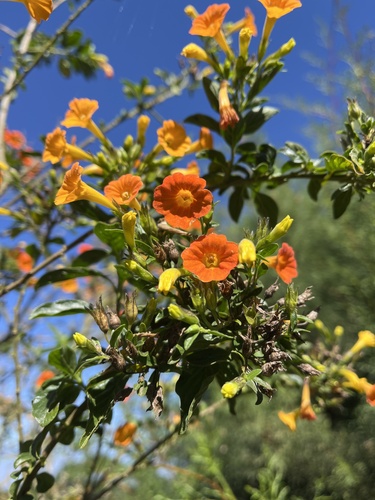
Streptosolen jamesonii (Benth.) Miers is a straggling, evergreen, densely branched shrub that reaches 1.5–2 m in height. It is covered in rough, short hairs and has abundant glandular trichomes. Its stems are generally tall and slender. The leaves are ovate to elliptic, petiolate, and subcoriaceous, ranging from green to dark green, with a fine wrinkled pattern. Lower leaf surfaces have prominent nerves, while upper leaf surfaces lack stomata. Flowers are produced in subcorymbose cymes, with pedicels 5–16 mm long. The calyx is tubular, zygomorphic, net-veined, 8–10 mm long, and has 4–5 unequal teeth that are shorter than the calyx tube. The corolla is funnel-shaped, zygomorphic, 20–30 mm long, and golden-yellow when young, maturing to golden-reddish; its tube is slender, spirally contorted, and not ventricose, while the somewhat slanted, narrow limb can reach up to 18 mm across and has 5 broad, very short lobes that are either apiculate or emarginate. There are four stamens (the anterior stamen is missing), with filaments that bear hairs. The upper lateral pair of stamens has short filaments around 3 mm long, smaller anthers, and is attached in the upper two thirds to three quarters of the corolla; the lower posterior pair has long filaments around 12 mm long, larger anthers measuring 2.5 x 1.8 mm, and is attached near the basal quarter of the corolla. Pollen grains are oblate-sphaeroidal and medium-sized, and the nectary is annular and thick. Seed capsules are globose to ovate, around 5 mm long, and hold 60–80 seeds. Seeds are 0.6–0.9 mm long, cuboidal-elongated, with a reticulate testa. In regions with mild winters, blooms can appear nearly year-round, with the heaviest flowering occurring from February to July. Botanists from the Natural History Museum, London have described the corolla as 'essentially upside-down' due to the twisted corolla tube, which gives the genus its name. Streptosolen jamesonii flowers profusely over several weeks and produces abundant nectar. Nectar secretion begins around the time the flower opens and continues for approximately three days. Anther dehiscence coincides with the start of nectar secretion. As flowers mature, their colour changes progressively from yellow through orange to scarlet, allowing pollinators to accurately estimate flower age and likely nectar content from flower colour. Nectar accumulates inside the corolla tube. The California Poison Control System assigns this plant a toxicity rating of 4, which indicates major health risk if consumed, especially in large amounts, with likely serious effects to the heart, liver, kidneys or brain. Existing accounts of Streptosolen jamesonii toxicity are somewhat vague, and are based on its membership in a plant family known for many toxic species rather than well-documented poisoning cases. Streptosolen jamesonii is one of up to 71 medicinal plant species from 33 plant families used to prepare Ecuadorian Horchata, a tonic drunk to improve physical and spiritual well-being in Ecuadorian folk medicine. The term horchata comes from the Latin hordeum (barley) and refers to a wide variety of soft drinks consumed across Spain and Latin America, the most well-known being horchata de chufas, or tiger nut 'milk'. The distinct medicinal Ecuadorian horchata is most popular in southern Ecuador, particularly in the province of Loja. Rios et al. (2017) list Streptosolen jamesonii as an ingredient of this tonic drink for its claimed anti-inflammatory properties. In the Ayabaca district of the Piura Region in the northern Peruvian Andes, S. jamesonii, known locally as San Juan (Saint John), is used as a pediatric anthelmintic (treatment for intestinal worms). A whole-plant decoction is made by boiling around 20 g of plant material in one litre of water for thirty minutes. This decoction is drunk on an empty stomach to kill or stun the worms, and is followed by a purge (usually Huaminga) to expel the parasites from the bowels. Huaminga is the local common name for a club-moss species in the genus Huperzia. To make the purge, around 50 g of the whole Huaminga plant is ground and boiled in one litre of water until the volume reduces to 250 ml; a cupful of the cooled decoction acts as a drastic purgative. When prepared as a less concentrated decoction and consumed over several days, Huaminga is also said to be an anthelmintic on its own. Note: By an oversight, De Feo (2003) lists 'S. jamesonii' under the genus Solanum. While the binomial Solanum jamesonii does exist, De Feo almost certainly intended the genus Streptosolen rather than Solanum: De Feo cites the authorship as '(Benth.) Miers', which matches Streptosolen jamesonii, while the valid binomial Solanum jamesonii Bitter is a synonym of Solanum oblongifolium Dunal.