About Streptoprocne rutila (Vieillot, 1817)
Taxonomic Placement
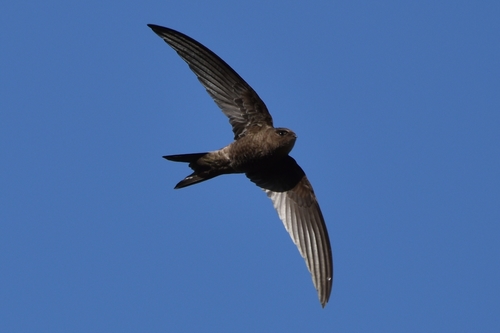
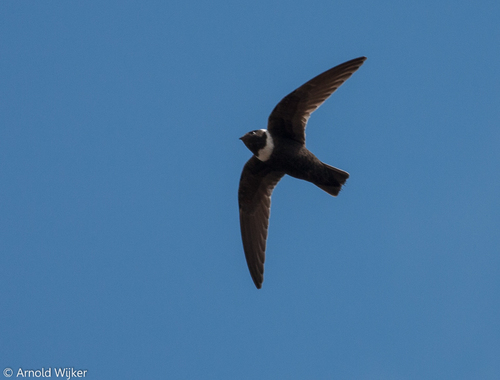
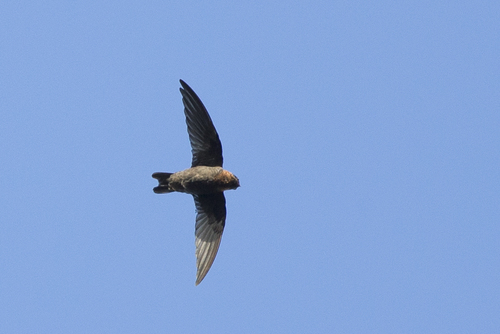
The chestnut-collared swift (Streptoprocne rutila) is one of the smaller species in the genus Streptoprocne.
Size and Weight
It measures 12 to 14 cm (4.7 to 5.5 in) in length and weighs approximately 21 g (0.74 oz).
Body Structure
It has a wide, slightly notched tail and broad wings.
Nominate Male Plumage (Upperparts)
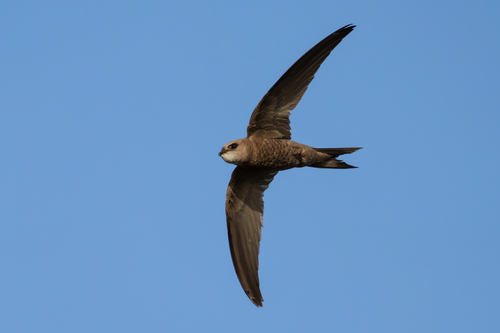
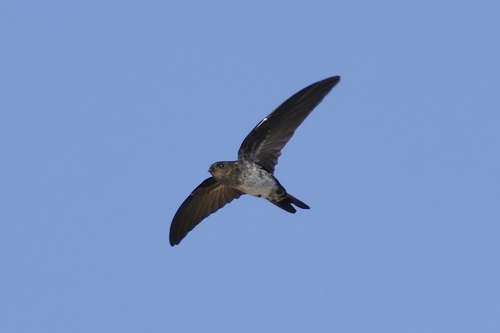
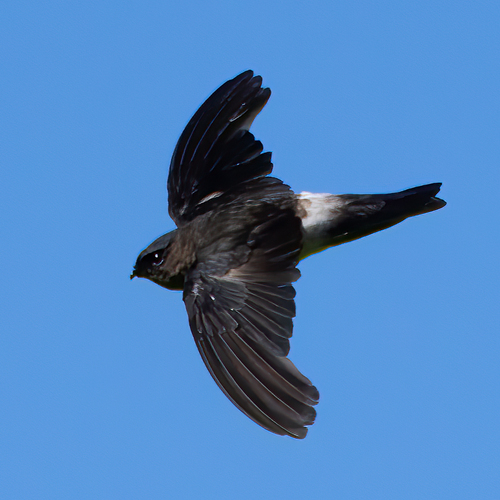
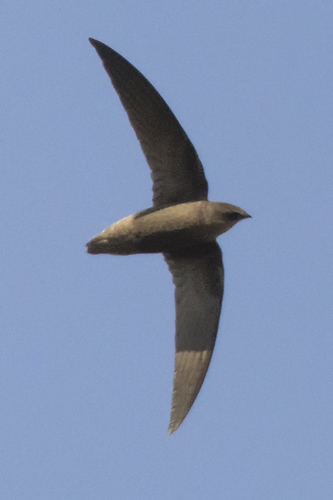
For adult males of the nominate subspecies S. r. rutila, the crown is sooty blackish brown, the back is blackish brown, the rump and uppertail coverts are slightly paler, and the tail is sooty blackish brown.
Nominate Male Facial Plumage
They have a narrow black patch surrounding the eye, with grayish brown cheeks, chin, and throat mixed with some dull rufous feathers.
Nominate Male Collar
A wide rufous collar crosses their lower throat and upper breast, extending around to the nape.
Nominate Male Wing Plumage
The upper side of their wing shows various shades of black, and the underside is slightly lighter.
Nominate Male Underparts
Their underparts are a paler blackish brown than their upperparts.
Female Plumage
Adult females have paler body plumage than males, with a much smaller rufous collar or no collar at all.
Juvenile Plumage
Juveniles have a similar appearance to adult females but are paler overall.
S. r. griseifrons Plumage
The subspecies S. r. griseifrons has sooty gray rather than nearly black upperparts, sooty grayish brown underparts, and pale gray fringes on most facial feathers.
S. r. brunnitorques Distinction
The subspecies S. r. brunnitorques cannot be clearly distinguished from the nominate subspecies.
Subspecies Range Overview
The distributions of the three subspecies of chestnut-collared swift are as follows: S. r. griseifrons is found in western Mexico, from Sinaloa, Durango, and Zacatecas south to Oaxaca; S. r. brunnitorques ranges from southeastern Mexico through Central America and along the Andes of Colombia, Ecuador, Bolivia, and Peru; S. r. rutila occurs in the Andes and Coastal Ranges of Venezuela, and on Trinidad.
Range Boundary Uncertainty
The exact boundaries of each subspecies' range are not fully known.
Disputed S. r. griseifrons Records
Some specimens have been attributed to S. r. griseifrons that were collected in Venezuela and much further south, though few taxonomists accept these identifications.
S. r. brunnitorques Taxonomic Disputes
Some taxonomists extend the range of S. r. brunnitorques into Venezuela, an area that most taxonomists assign to S. r. rutila, and some have proposed that brunnitorques should be merged into rutila.
Habitat Types
The chestnut-collared swift lives in a variety of landscapes, including humid montane forests, pine-oak forests, semi-deciduous forest, evergreen forest, semi-open areas, and small human communities.
Elevation Range
Its elevation range varies by region: from a few hundred meters above sea level up to 3,000 m (9,800 ft) in Mexico and northern Central America, 2,500 m (8,200 ft) in Costa Rica and Colombia, 2,700 m (8,900 ft) in Ecuador, and 3,100 m (10,200 ft) in Bolivia.