About Streptanthus polygaloides A.Gray
Streptanthus polygaloides, also called S. polygaloides, has flowers that do not look like those of other crucifers, and instead resemble Polygala (milkworts). This resemblance is the source of both the plant's scientific species name and its common name. Because S. polygaloides differs greatly from other members of the Streptanthus genus in both morphology and ecology, the evolutionary history of this plant remains unclear. This uncertainty led Kruckeberg to state that "The origin of this bizarre species is an 'abominable mystery'."
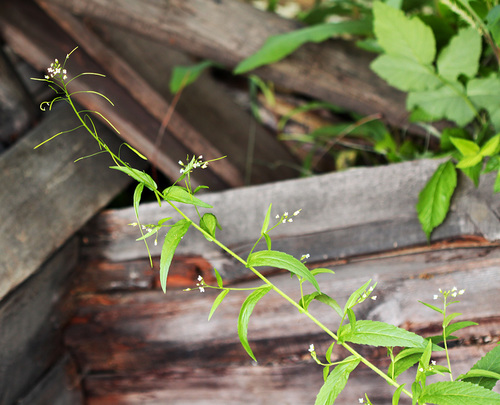
S. polygaloides is an annual herb. It grows a hairless stem, which sometimes has a waxy texture. Stem height ranges from under 10 centimeters to nearly 1 meter. The plant's basal leaves are ephemeral, with blades divided into narrow segments and attached to petioles. Leaves positioned higher on the stem have simple, linear blades that can reach up to 10 centimeters in length, and these leaves do not have petioles.
Flowers grow at intervals along the upper section of the stem. Each flower has a folded, hooded calyx made of deeply keeled sepals, which range in color from greenish yellow to purple. White petals marked with brown veins emerge from the tip of the calyx. The plant produces fruit as a smooth, straight silique that can be flat or four-angled, and reaches up to 5 centimeters in length.