About Streptanthus campestris S.Watson
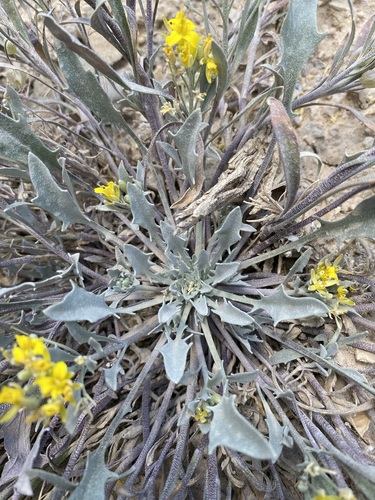
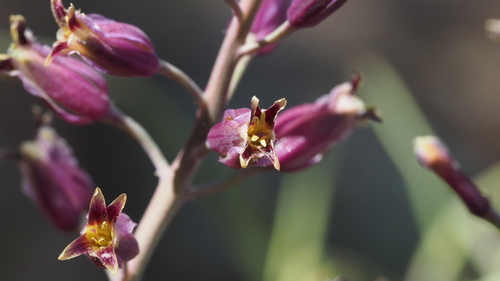
Streptanthus campestris, commonly called the southern jewelflower, is a flowering plant species in the mustard family. It is native to southern California (United States) and northern Baja California (Mexico), with fewer than 20 known scattered occurrences, ranging from San Bernardino County, California, to Sierra de San Pedro Mártir in northern Baja. This plant grows in mountain chaparral, woodlands, and forests, at elevations up to 2300 meters (7545 feet). It is a perennial herb that forms a thick, rarely branched stem, reaching up to 1.5 meters tall or taller. Its basal leaves have fleshy oval blades with bristly, toothed edges, and grow on petioles. Leaves higher up the stem are lance-shaped with smooth or wavy edges, and their bases clasp the stem. Flowers grow at intervals along the upper section of the stem. Each flower has a bell-shaped calyx made of purple bristle-lined sepals, with four yellow petals tipped in purple emerging from the calyx tip. The fruit is a narrow silique that can be straight or curved, and may reach up to 14 centimeters in length. This already uncommon species is moderately threatened by ongoing habitat fragmentation.