About Streptanthus breweri A.Gray
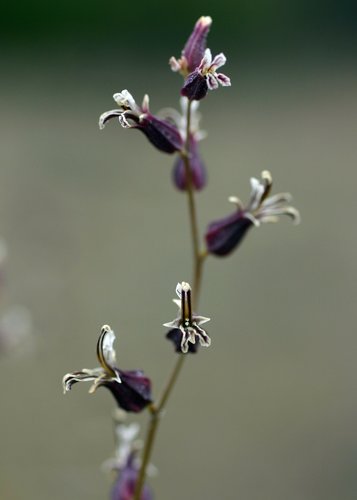
Streptanthus breweri is a species of flowering plant in the mustard family, commonly called Brewer's jewelflower. This species is endemic to California, occurring in coastal mountain ranges from the Klamath Mountains south to the San Francisco Bay Area. It grows in chaparral and woodland habitats, most often on serpentine soils. It is an annual herb that grows an upright, branching stem reaching a maximum height of around 80 centimeters. The plant is hairless aside from fine hairs on parts of its inflorescence, and may have a waxy texture. Basal leaves have oval blades attached to petioles, while leaves higher on the stem are lance-shaped and clasp the stem at their bases. Flowers grow at intervals along the upper stem, sometimes arranged in a zig-zagging, one-sided cluster. Each flower has an urn-shaped calyx made of keeled greenish or purplish sepals less than one centimeter long. White, purple, or purple-veined white petals emerge from the tip of the calyx. The fruit produced by the plant is a narrow, curved silique that can measure 9 to 11 centimeters in length. Leaf blades of this plant sometimes bear hardened, orange-pigmented callosities that are thought to mimic butterfly eggs. Female California White butterflies (Pontia sisymbrii, synonym Pieris s.) lay their eggs on Streptanthus leaves, and females prefer to lay on leaves that do not already hold eggs. A single larva can consume an entire plant, so the butterfly assesses existing egg load to estimate future competition for its offspring. Leaves with callosities strongly resemble the butterfly's orange eggs, so egg-laying females are far less likely to visit these leaves, protecting the plant from herbivory.