About Strelitzia reginae Banks
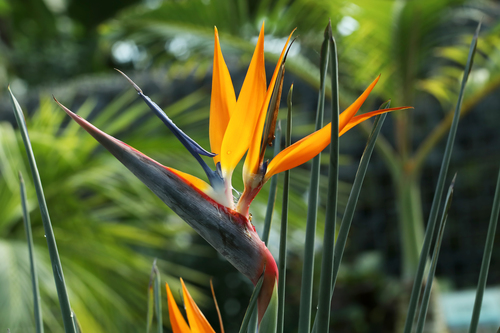
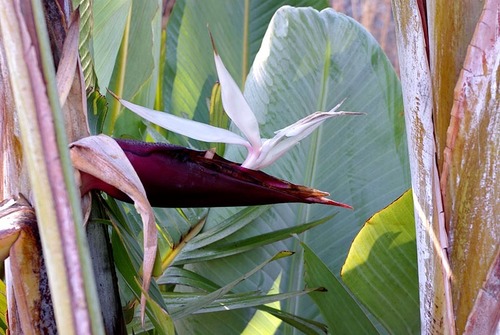
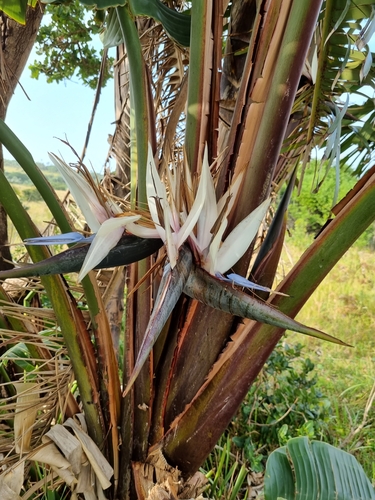
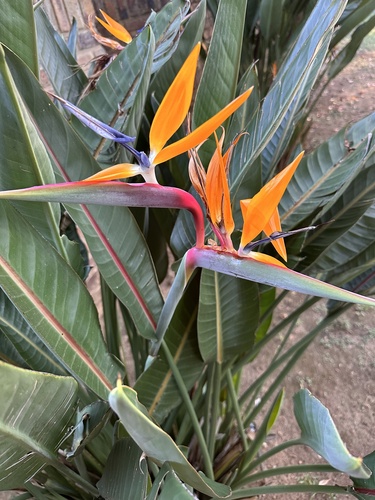
Strelitzia reginae Banks grows to 2 meters (6 1⁄2 feet) tall. It produces large, sturdy evergreen leaves that measure 25–70 cm (10–28 inches) long and 10–30 cm (4–12 inches) wide, borne on petioles that can reach up to 1 m (40 inches) in length. The leaves are arranged in two opposite ranks, forming a fan-shaped crown. Flowers grow above the foliage at the ends of long stalks. The hard, beak-shaped sheath that the flower emerges from is called a spathe. The spathe is positioned perpendicular to the stalk, which gives it the look of a bird’s head and beak, and it also acts as a sturdy perch for sunbirds, the pollinators of this species. Flowers emerge one at a time from the spathe, and each flower has three bright orange sepals and three petals that are either purplish-blue or white. Two of the petals are fused together to create an arrow-shaped nectary. When a sunbird sits on the spathe to feed on nectar, the third petal opens to expose the anther, which deposits pollen onto the bird’s feet. Strelitzia reginae is an extremely popular ornamental plant. It was first introduced to Britain in 1773, where it was grown at the Royal Botanic Gardens, Kew. After its introduction, it was spread widely across the globe, including to the Americas and Australia, and grows well in any sunny, warm location. In the United States, Florida and California are the main regions where it is cultivated, due to their warm climates; it is a common ornamental in Southern California, and has been selected as the official flower of the City of Los Angeles. In regions with cold winters, it is typically grown indoors under glass in a cool, sunny location like a greenhouse or conservatory, since it can only tolerate light frosts and does not thrive in temperatures below 10 °C (50 °F). It can be moved outdoors during the warm summer months. This species has been awarded the Royal Horticultural Society's Award of Garden Merit. It is a low-maintenance plant that is easy to grow in gardens, is fairly tolerant of a wide range of soil conditions, and requires little water once it is fully established. When well cared for, it will flower multiple times per year. It grows best in rich loamy soil, and produces the best growth when given plenty of water year round. It tolerates conditions from full sun to partial shade, and responds well to regular fertilization with controlled-release fertilizer and additions of compost. It is sensitive to cold and needs shelter from frost, as frost can damage its flowers and leaves. S. reginae can be propagated either by seed or by division of existing clumps. Seedlings grow slowly and will not produce flowers for 3 to 5 years after germination, though exceptionally vigorous seedlings may flower as early as two years. It only flowers once it is properly established, and dividing established plants can disrupt their flowering schedule. Once open, the flowers are quite long-lasting. Peak flowering occurs in winter and early spring. There is a yellow-flowered cultivar of this species called ‘Mandela's Gold’.