About Stolonica socialis Hartmeyer, 1903
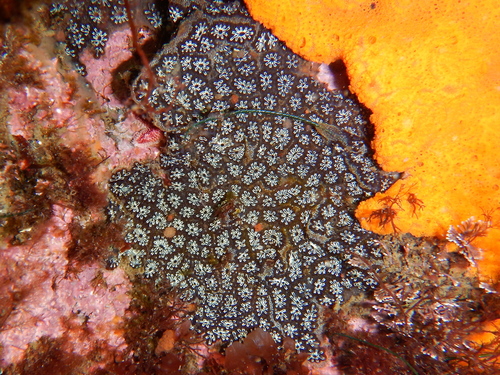
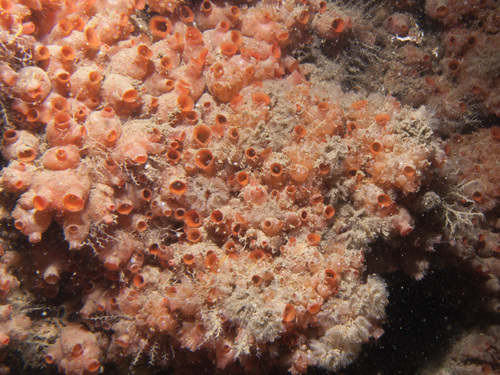
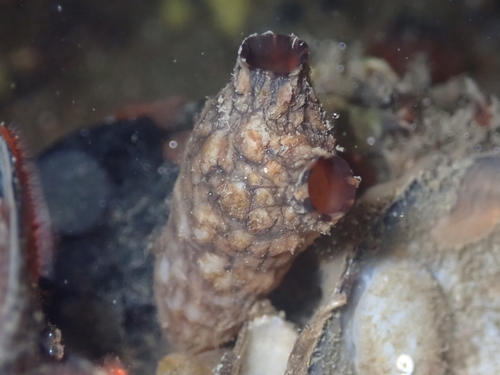
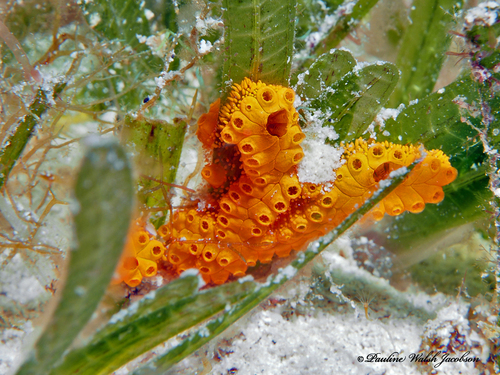
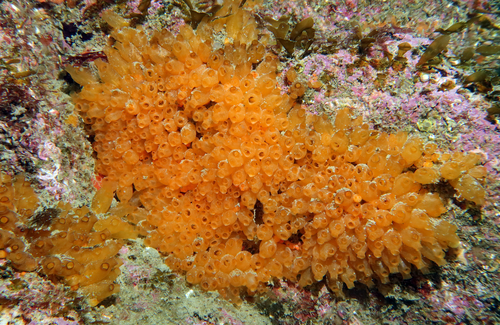
Stolonica socialis is a colonial tunicate that forms small clusters of zooids. These clusters are joined at the base by a mat of stolons. Each zooid grows up to 2 cm (0.8 in) high, and has a rectangular or ovoid shape. Both small siphons on each zooid are located near the apex of the zooid. The outer surface of each zooid is smooth, and sand does not stick to it, but sand does adhere to the stolon mat. Most colonies are orange, though some colonies are yellow and others are pale brown. Colonies spread across rock surfaces and can form large sheets. In winter, orange-red buds develop on the stolons.
This species can be confused with the similar species Dendrodoa grossularia and Distomus variolosus, but both of these similar species are red. Stolonica socialis occurs in the northeastern Atlantic Ocean, the Irish Sea, and the English Channel. Its known range includes the coasts of northwestern Ireland, southeastern Ireland, Wales, southwestern England, and northwestern France. It grows on rocks, including rocks exposed to strong currents, at depths of 5 to 35 m (16 to 115 ft) or greater. It prefers shaded rocks, boulders, and overhangs, and can form large populations. During exceptionally low tides, it may be found under overhanging rocks on the foreshore.