About Stilpnia larvata (Du Bus de Gisignies, 1846)
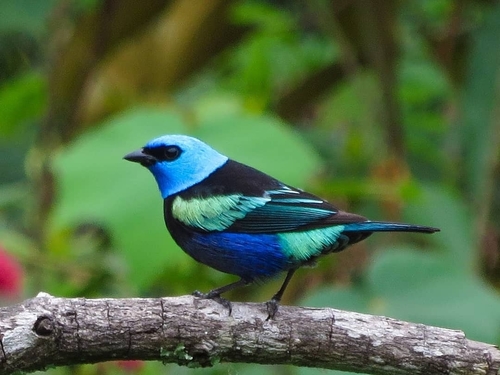
The golden-hooded tanager, with the scientific name Stilpnia larvata, is a medium-sized passerine bird. It is a resident breeder that ranges from southern Mexico south to western Ecuador, and occurs from sea level up to 1,500 metres (4,920 ft) in altitude, where it inhabits the canopy of dense forests as well as semi-open areas including clearings, second growth, and well-vegetated gardens. Adult golden-hooded tanagers measure 13 cm (5.1 in) in length and weigh 19 g (0.67 oz). The adult male has a golden head with a black eyemask bordered by violet blue above and below. Its upper body is black, with the exception of turquoise shoulders, rump, and edgings on the wings and tail. It has blue flanks and a white central belly. Females have a greenish tinge to the head, sometimes with black speckling on the crown, and more extensively white underparts. Immature birds are duller overall, with a green head, dark grey upperparts, off-white underparts, and very little blue in their plumage. The call of the golden-hooded tanager is a sharp tsit, and its song is a tuneless rattled series of tick sounds. Golden-hooded tanagers live in pairs, family groups, or join mixed-species feeding flocks. Their diet includes small fruit such as that of Trophis racemosa in the family Moraceae, which they usually swallow whole, and they also eat insects. They build cup-shaped nests in tree forks or bunches of green bananas. A normal clutch consists of two white eggs marked with brown blotches. This species is often double-brooded, and young birds from the first clutch help feed the chicks of the second brood.