About Stilpnia cyanicollis (d'Orbigny & Lafresnaye, 1837)
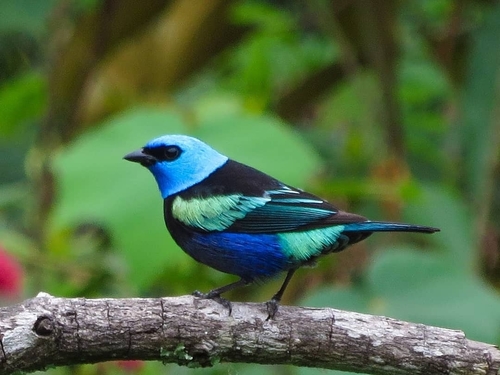
The blue-necked tanager, scientifically named Stilpnia cyanicollis, is a species of bird in the Thraupidae family. It occurs in South America, ranging from Colombia to Bolivia. Its natural habitats include subtropical or tropical moist lowland forest, subtropical or tropical moist montane forest, and heavily degraded former forest. On average, this tanager measures 12 cm (4.7 in) in length and weighs approximately 17 g (5⁄8 oz). Adults have a blue hood and throat. Their wing coverts, wing edges, and rump range in color from turquoise to greenish straw. Their posterior underparts are black, violet, or blue. Adult blue-necked tanagers show slight regional variation in coloration. Their beaks, legs, and feet are black. Juveniles are brownish gray, with faint traces of the adult color pattern. The diet of the blue-necked tanager includes fruits, berries, flower blossoms, and insects. These tanagers glean insects from leaves, or sometimes catch them in flight, but fruit makes up the majority of their diet. The female constructs a well-concealed cup nest from moss, and lays an average clutch of 2 white eggs marked with brown spotting. Incubation of the eggs lasts 13 to 14 days, and the chicks fledge 15 to 16 days after hatching. Both the male and female feed the nestlings a diet of insects and fruit, and they may also receive help from additional helpers at the nest.