About Stilpnia cayana (Linnaeus, 1766)
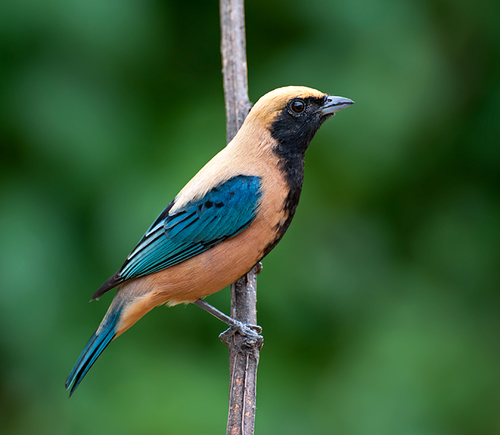
The burnished-buff tanager has the scientific name Stilpnia cayana (Linnaeus, 1766). This species includes several subspecies, which are divided into two main groups: the northern and western cayana group, and the southern and eastern flava group. The subspecies huberi, found on Marajó Island, is intermediate between these two main groups. Males belonging to the cayana group have an orange-rufous crown, a black mask, and cream underparts that are distinctly tinted blue on the throat and chest. Males of the flava group have an orange-buff crown, buff underparts, and a black patch that extends from the mask, over the throat and central chest, down to the mid-belly. Males from both groups have turquoise wings and tail. Females are duller in coloration than males, and black markings on females are restricted to a poorly demarcated "shadow" mask. This tanager is distributed across the northern Guianas, most of Venezuela, and east-central Colombia. It is also found near the outlet of the Amazon River in Brazil, across most of eastern Brazil, in Paraguay, and in northeast Argentina. It occurs very locally in Bolivia and Peru. It can live in nearly any semi-open habitat that contains trees, including human-altered habitats such as gardens, plantations, and parks.