About Sternochetus mangiferae (J.C.Fabricius, 1775)
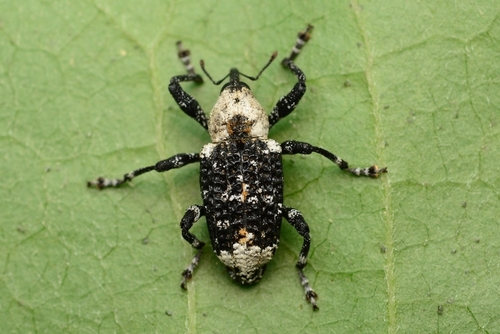
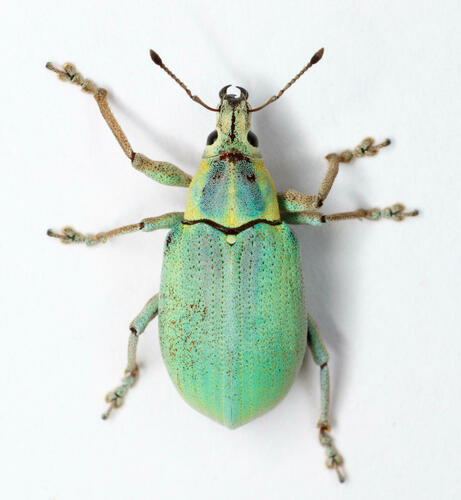
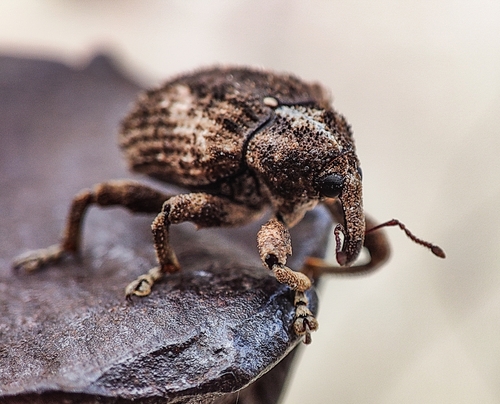
Sternochetus mangiferae is a weevil that is commonly known by the common names mango seed weevil, mango stone weevil, or mango weevil. It is a compact weevil that is characteristic of the Cryptorhynchinae subfamily. This species was first described in 1775, originally placed under the genus Curculio. Adult S. mangiferae measure 7.5 to 9.5 mm in length and 4 mm in width. Their overall color is variable, and their bodies can be covered with black, greyish, reddish, or yellowish scales. In Australia, adult weevils of this species are dark brown to black with grey markings. When an adult is disturbed, it presses its legs against its body, and fits its beak into a groove located on its underside. Females have an elevated ridge at the apex of the pygidium, while this area is rounded in males. Adults are not strong fliers, and are not found far from fallen fruit. New areas become infested when humans transport infested fruit. The eggs of this species are elongated and creamy white, and covered in a protective brown coating, with two tiny tails at one end. S. mangiferae is widespread, and occurs in most countries, particularly in locations where mangoes are grown. Adult females lay eggs on the surface of mango fruit. Larvae and pupae develop inside the fruit, and adults emerge by cutting their way out of the seed and pericarp after the fruit falls and decays. Adults enter diapause that lasts until the next mango fruiting season. S. mangiferae is considered a pest of mangoes. Mangoes (Mangifera indica) originated in Myanmar and north-east India, and S. mangiferae most likely originated in the same region. This species is distributed across nearly all mango-growing regions of the world, including: Australasia and Oceania, Asia, Africa, Hawaii (North America), the Caribbean, and French Guiana and Brazil (South America). It is not present in the Canary Islands (Spain), Italy, Israel, Egypt, and Western Australia, regions where mangoes are grown on a limited but increasing scale.