About Sternbergia colchiciflora Waldst. & Kit.
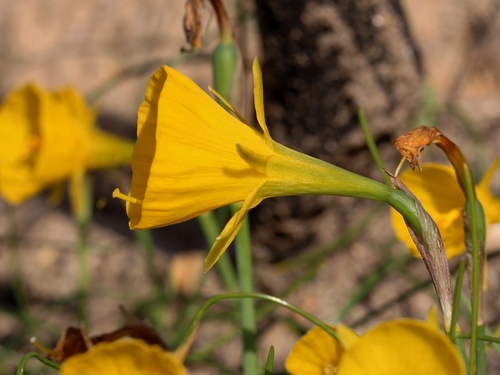
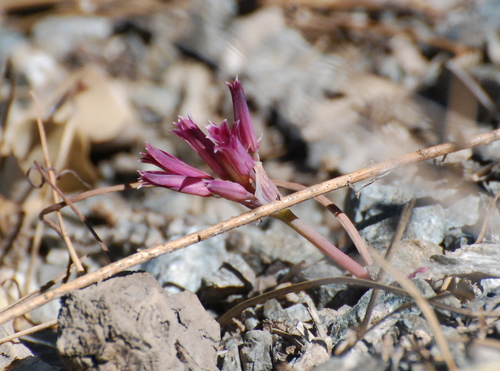
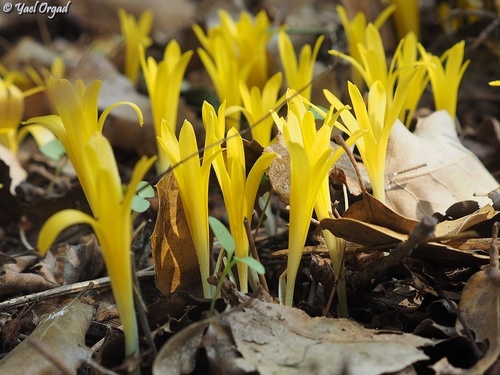
Sternbergia colchiciflora is the smallest member of the autumn-flowering group known as "gold crocuses". Each of its bulbs is only 0.5–1.5 cm (0.20–0.59 in) in diameter, and produces three to six thread-like leaves after the plant finishes flowering. The foliage is 1–4 mm wide, colored blue-green to dark green, and often twists into a loose spiral as it elongates over winter. Its solitary flower emerges directly from the ground between September and November, growing from a very short, subterranean stalk. The narrow yellow perianth tube measures roughly 18–27 mm; the six outer segments are just 2.3–3.3 cm long and 2–5 mm wide, giving the bloom a distinctly slender shape. Because both the ovary and young capsule develop safely below the soil surface, the species can set seed even when bad weather blocks insect visits: the unopened flower is able to self-pollinate underground, a process called kleistogamy. By early spring, the capsule is pushed one or two centimeters above the surface, where the seeds—each tipped with a fleshy food-body—are collected by ants and dispersed locally. The species ranges widely from south-eastern Spain through the Balkans and Italy to the Caucasus, the Iranian plateau and western Turkey. It grows in open, rocky grassland, light scrub and field margins on well-drained calcareous soils, at elevations between 150 m (490 ft) and roughly 2,300 m (7,500 ft). In Mediterranean and steppe climates, the bulb survives a long, hot summer dormancy; once autumn rain arrives, a brief display of slender, pale to deep-yellow flowers may appear across otherwise brown turf. Its small size and tendency to hide its flowers under surrounding vegetation mean natural populations are often overlooked, but the plant produces reliable amounts of seed and can form loose colonies on undisturbed ground. In gardens, it only succeeds when given an extended, warm, completely dry rest and a gritty, lime-rich compost; planting several bulbs together in a pot or the sunniest, most free-draining spot of a rock garden makes this subtle display easier to appreciate.