About Stereum sanguinolentum (Alb. & Schwein.) Fr.
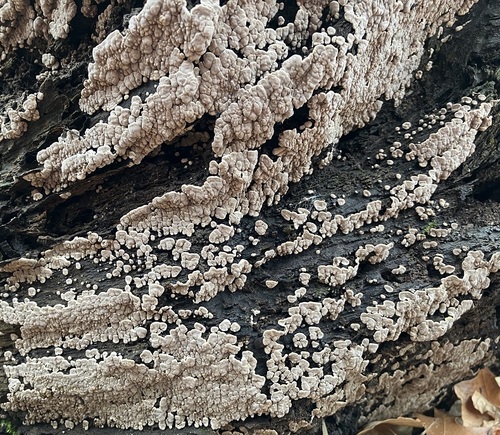
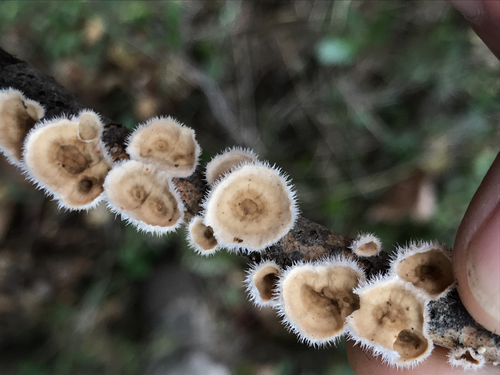
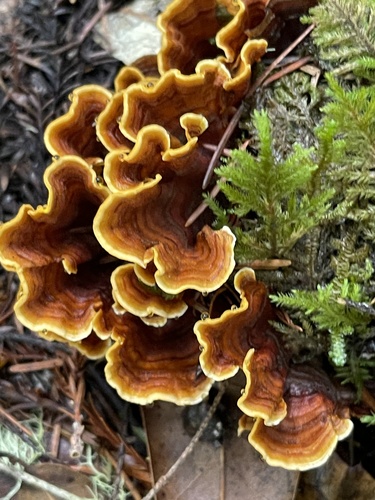
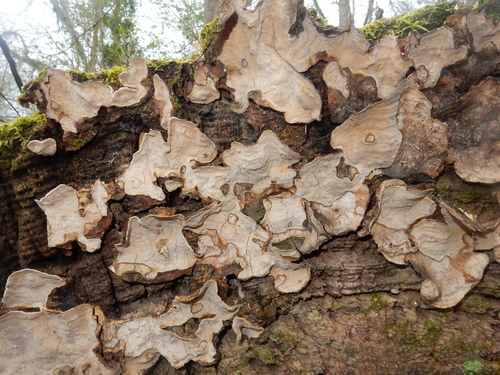
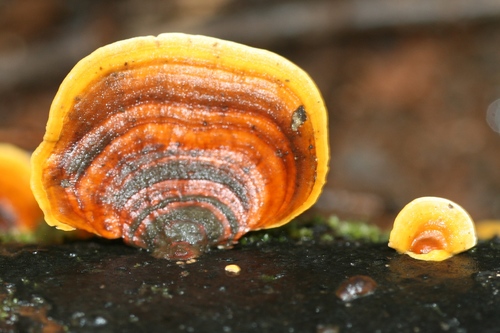
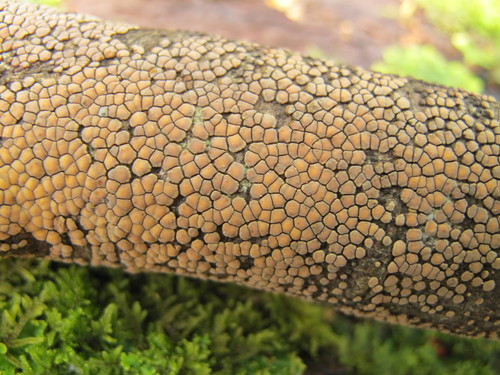
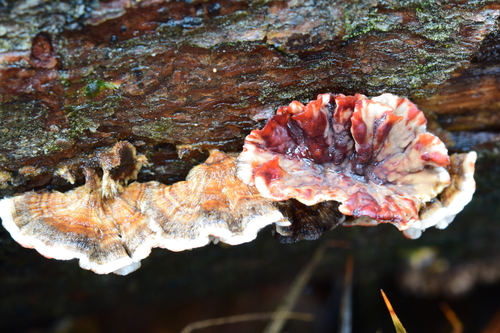
The fruit body of Stereum sanguinolentum grows as a thin leathery crust, typically less than 1 mm thick, on the surface of host wood. Its upper edge often curls to form a narrow shelf, usually less than 10 mm thick, and any existing shelves may fuse with or overlap adjacent shelves. The fruit body surface is covered in a layer of fine, felt-like hairs, which are sometimes pressed flat against the surface. Mature fruit bodies range in color from beige to buff to dark brown, with lighter-colored margins. When injured, fresh fruit bodies exude a red liquid, and touching them will leave red bruises. Dried fruit bodies turn greyish-brown. The spores are ellipsoid to cylindrical, amyloid, and typically measure 7–10 by 3–4.5 μm. Stereum sanguinolentum can be parasitized by the jelly fungus Naematelia encephala, which has the synonym Tremella encephala. This fungus causes brown heart rot, which produces wood that is light brown to red-brown, dry, and stringy in texture. A cross-section of infected wood shows a circular infection surrounding the center of the log. The fungus enters host plants through open wounds created by mechanical damage or grazing wildlife. Mycelium fragments can be spread by wood wasps of the genus Sirex. The rot spreads up to 40 cm (16 in) per year. The fungus has been recorded growing on balsam fir, Douglas fir, and western hemlock. It is geographically widespread, with recorded occurrences in North America, Europe, East Africa, New Zealand, and Australia. Stereum sanguinolentum is an amphithallic basidiomycete. During reproduction, monospore intrabasidiome pairings are always compatible, which helps the fungus spread easily. Monobasidiospore and trama isolates are plurinucleate, have clamp connections, and are often dikaryotic. Basidiospores are heterokaryotic, which confirms the species is amphithallic. The mycelia that spread the fungus grow from heterodikaryotic spores that originate from basidiospores. Genetic recombination occurs either through mating between homokaryons from monokaryotic basidiospores, or through a parasexual process. Stereum sanguinolentum is an extremely fast colonizer of newly dead or wounded conifer sapwood. Its amphithallic life cycle gives it selective advantages that improve survival and dispersal. Dispersal only occurs via basidiospores, and the most common dispersal mechanism is wind. These wind-blown basidiospores are produced parthenogenically, meaning reproduction develops from an ovum without fertilization. In white rot, infection happens when spores land near wounds, or when mycelial fragments are transmitted by wood sap. Rot extension spreads extremely quickly in the first few years after infection, and spreads even faster when the infected injury is located at the root collar rather than the stem.