About Stereum ostrea (Blume & T.Nees) Fr.
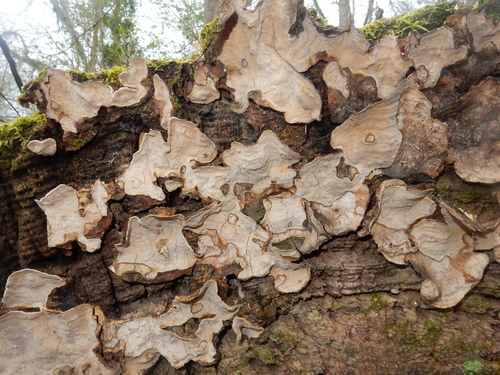
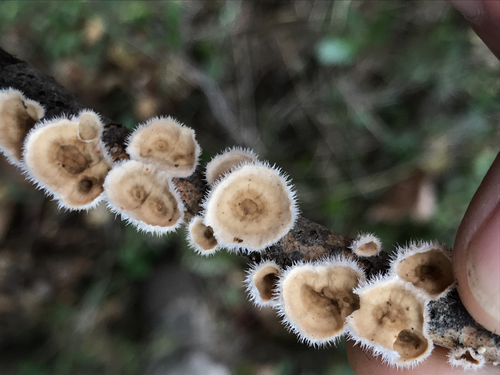
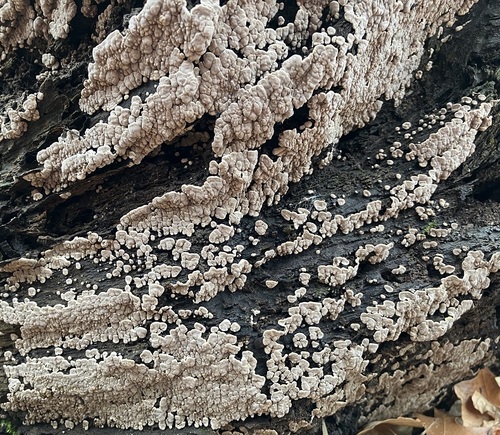
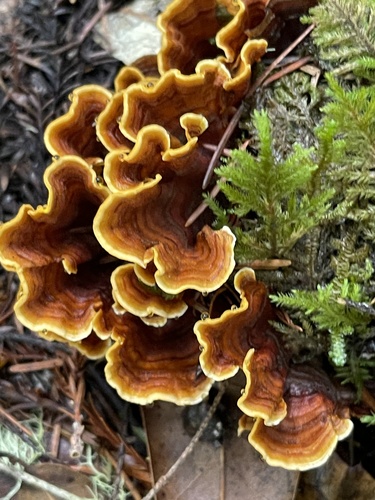
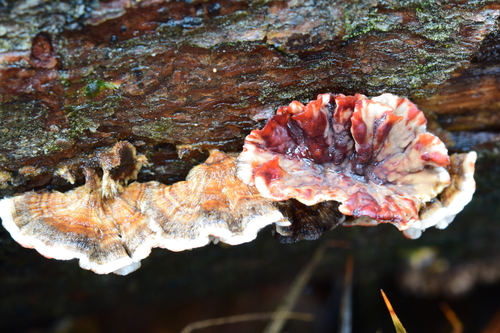
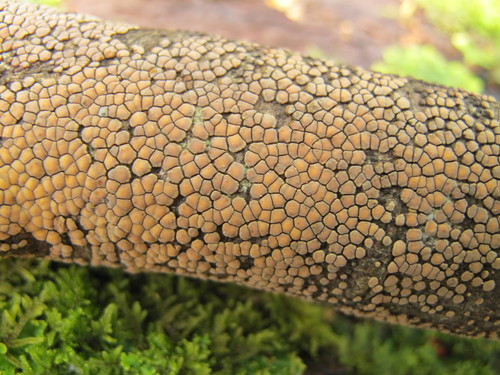
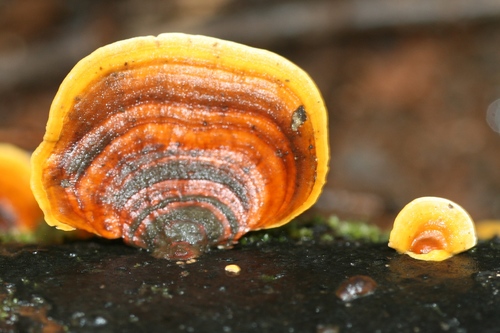
This fungus is commonly called false turkey-tail because it mimics the appearance of Trametes versicolor. It can be distinguished from T. versicolor by the underside of its fruiting body: T. versicolor has many pores here, while S. ostrea does not. S. ostrea is also more red in overall color than T. versicolor. Compared to other species in the genus Stereum, S. ostrea can be told apart by its relatively large size and shell-like, rather than flat, body shape. The fruiting body of S. ostrea is 1–7 cm (0.39–2.76 in) wide, thin, and shell-shaped. Its surface may start out either hairy or smooth, and becomes smoother as the fungus ages. The concentric zones on its surface show a range of colors from yellowish red to dark brown. If algae colonize the surface, the fungus will appear green. Its flesh is very thin, too tough to eat, and has no distinct odor. The fungus does not have a stem. The underside is smooth, poreless, and colored white, gray, or reddish-brown. Its spores are white, and measure 5.5–7.5 μm (0.0055–0.0075 mm) by 2–3 μm (0.0020–0.0030 mm). This species is inedible. Stereum ostrea is saprophytic and also acts as a plant pathogen. It grows on the bark of hardwood trees, especially oak, as well as on decaying plant parts, and leaves white deposits where it grows. It grows individually but in dense groupings. Another fungus, Phlebia incarnata, is most commonly found growing alongside or even intermingled with S. ostrea. S. ostrea itself can be parasitized by jelly fungi. It grows year-round and is found in Indonesia.