About Stephanoaetus coronatus (Linnaeus, 1766)
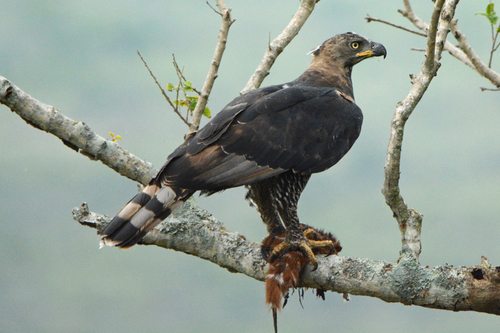
The crowned eagle (Stephanoaetus coronatus) is a very large eagle species. It measures 80 to 99 cm (31 to 39 in) in total length, making it the fifth longest extant eagle in the world. Females are 10–15% larger than males, weighing 3.2–4.7 kg (7.1–10.4 lb) while males weigh 2.55–4.12 kg (5.6–9.1 lb). Different sources report different average body masses: one account cites an average of 3.64 kg (8.0 lb), another claims an average of 3.8 kg (8.4 lb), and a South African survey recorded slightly smaller average weights: 2.65 kg (5.8 lb) for 5 males and 3.71 kg (8.2 lb) for 8 females. Overall, the crowned eagle ranks as the 9th heaviest living eagle species. Its wingspan typically ranges from 1.51 to 1.81 m (4 ft 11 in to 5 ft 11 in). The largest confirmed wingspan for a female is 1.9 m (6 ft 3 in), while unconfirmed claims report wingspans up to 2 m (6 ft 7 in). For a bird of its size, the crowned eagle has a relatively short wingspan: its average wingspan is roughly the same as that of a tawny eagle (Aquila rapax) or short-toed snake eagle (Circaetus gallicus), species that weigh about half as much as the crowned eagle. Its wings are somewhat boxy, rounded, and quite broad, broader than the wings of the much longer-winged golden eagle (Aquila chrysaetos). This wing shape gives the crowned eagle high maneuverability in its densely wooded habitat. Wing chord measures 445–532 mm (17.5–20.9 in), with a median of 467 mm (18.4 in) in males and 512 mm (20.2 in) in females. In the South African survey, 5 males had an average wing chord length of 475.2 mm (18.71 in) and 7 females had an average of 506.9 mm (19.96 in). While the crowned eagle is on average lighter and has a smaller wingspan than the often sympatric martial eagle, its average total length is greater than the martial eagle's, due to the crowned eagle's much longer tail. The crowned eagle's tail measures 300 to 410 mm (12 to 16 in) long, with a median of 315 mm (12.4 in) in males and 348 mm (13.7 in) in females. In the South African sample, 4 males had an average tail length of 320.4 mm (12.61 in) and females had an average of 352.4 mm (13.87 in). Relative to its body size, the crowned eagle's bill is medium-sized. One large museum specimen had a bill measuring 55 mm (2.2 in) from gape, 45 mm (1.8 in) in culmen length, and 33 mm (1.3 in) in bill depth. In South Africa, culmen length averaged 50 mm (2.0 in) for 4 males and 54.9 mm (2.16 in) for 7 females, with a total range of 46.5 to 61.4 mm (1.83 to 2.42 in) across both sexes. For a raptor of its size, the tarsus is modest in length at 8.5–10.3 cm (3.3–4.1 in), and it is clearly shorter than the martial eagle's tarsus. However, the crowned eagle's feet and legs are visibly thicker and heavier than the martial eagle's, and its talons are quite massive in both length and width. Few comprehensive measurements of wild crowned eagle talon size are available. One female museum specimen had a hallux-claw (hind claw, the largest talon in accipitrids) of 6.2 cm (2.4 in), a 5-year-old (sexually mature) female measured 5.74 cm (2.26 in) in hallux-claw length, and an adult male measured 4.9 cm (1.9 in). In the South African sample, hallux-claw length averaged 52.4 mm (2.06 in) for 5 males and 60 mm (2.4 in) for 7 females, with a total range of 48.6 to 61.4 mm (1.91 to 2.42 in) across both sexes. These measurements place the crowned eagle's talon size around the same as the largest golden eagles, and half the size of a harpy eagle's. Unconfirmed claims credit captive crowned eagles with hallux-claw lengths up to 10 cm (3.9 in), similar to an unconfirmed report of a 13 cm (5.1 in) hallux-claw in a captive harpy eagle. In a small sample of large forest-dwelling raptors, the crowned eagle's front-left talon measured 4.74 cm (1.87 in), around one centimeter smaller than that of a harpy eagle or the recently extinct large Haast's eagle (Hieraaetus moorei), and slightly smaller than those of the Philippine eagle (Pithecophaga jefferyi). Given that large females of these other species can weigh up to twice as much as an average crowned eagle, this shows the relative large size of the crowned eagle's talons. Adult crowned eagles have striking plumage. Their crown is dark to rufous-tinged brown, with a prominent, often raised black-tipped double crest that can give the head a somewhat triangular shape. Adult upperparts are blackish brown-grey, with a variable blue tinge. The throat is brown, while the belly and breast are white densely overlaid with blackish bars and blotches, and variably marked with cream or rich buff-rufous coloration. The wing primaries are white at the base, broadly tipped with black, and crossed by two black bars. The tail is black with brownish-grey bands. The thighs and legs are barred and closely spotted with black and white. Adult underwing coverts have a bold chestnut coloration, lightly spotted with black. Adult crowned eagles have yellow to almost white eyes, an ochre-yellow cere and feet, and black talons. In the wild, adult crowned eagles are rarely misidentified, thanks to their distinct build and call. Their strongly barred outer wings and tail are diagnostic in flight. Features including the crest, upright perching posture, and large size are unique to this species, further simplifying identification. Although the species shows sexual size dimorphism, the difference is relatively modest, and it is usually not possible to sex individuals by size alone. Males can be distinguished by their faster wing beats: 4 to 5 beats per second, compared to the slower 3 to 4 beats per second of females. Like about half of species in the "booted eagle" group, juvenile crowned eagles have drastically different plumage from adults. There is considerable variation during the maturation process. The great majority of juveniles have a white head and underside, which contrast with the thighs and legs, which are heavily spotted with black. The juvenile's back is light brown or grayish-brown, with pale feather edges that often give the back a scaled appearance, especially on the upper-wing coverts. There is often a pinkish red wash on the upper chest. Recently fledged chicks tend to have dark patched faces, freckled bibs, slightly barred chests, and spotted legs. Less common juvenile plumages can occur even in birds under one year of age still under parental care: some juveniles are so heavily striped that they could easily be mistaken for two to three year old birds. The juvenile's tail is black with three pale bars and a narrow black tip. Juveniles have a grey cere and dull yellow feet. By 4 months after fledging, the inner thighs, previously poorly covered with downy feathers, are fully covered in small feathers. While pale 'morph' juveniles usually have unmarked tarsi just before leaving the nest, they quickly develop spots on the front of the tibio tarsal joint. The tibio tarsal pad remains bare and visible until the bird is one year old, after which it disappears, only to reappear on incubating females. Eye color is also variable: some juveniles have khaki light brown eyes just before fledging, while others already have adult-like yellow ochre eyes. For up to 15 months after leaving the nest, immature crowned eagles have plumage more similar to that of newly independent juveniles than adult plumage. Juvenile crowned eagles may be confused with similarly colored juvenile martial eagles, especially in flight. The crowned eagle can be distinguished from the martial eagle by its much longer, more heavily barred tail, much shorter wings, and spotted thighs. The crowned eagle is found only on the African continent. In East Africa, its range extends from central Ethiopia, through Uganda, forested parts of Kenya and Tanzania, south to eastern South Africa, with its southern distribution limit around Knysna. In western and central Africa, its range extends through much of what was once the vast African rainforest. It can be found from Senegal, The Gambia, Sierra Leone, and Cameroon, where it lives in the Guinean forests, east to the Democratic Republic of the Congo, where it occupies Congolian forests, and south as far as Angola. Despite having a large distribution in West Africa, the crowned eagle is now rare in many parts of the region. The crowned eagle mainly inhabits dense woodlands, including deep rainforest, but it can also sometimes be found in relict forest patches, wooded escarpments, riparian Acacia strips, heavily wooded hillsides, and rocky outcrops throughout its range. It occurs at altitudes from sea level up to at least 3,000 m (9,840 ft). Due to a lack of suitable current habitat, the species' range is often somewhat discontinuous. In the Democratic Republic of the Congo, the crowned eagle is confirmed to survive at relatively high densities in protected areas that retain dense, old-growth rainforest. In Kenya, 84% of the species' range falls within rainforest that receives more than 150 cm (59 in) of annual rainfall. In parts of East Africa where protected areas are mostly made up of fairly open habitat, crowned eagles usually live in wooded areas of rocky hills and narrow riverine strips, and only rarely range into the savanna surrounding the hills. Southern Africa has been the subject of the most comprehensive crowned eagle habitat study, largely because many areas there would seem inhospitable to a large raptor typically associated with old-growth forest. In southern Africa, the species' distribution south of the Limpopo River largely overlaps with montane forest, though it is not restricted to that habitat, and can secondarily range into plantations, usually eucalyptus plantations. In South Africa, it occurs in both lowland and montane evergreen forest, dense woodland, and forested ravines and gorges in open savannas and thornveld. In Zimbabwe, it can be found in fairly open woodland with Adansonia trees, and may occasionally forage in savanna and secondary growth. In Malawi, highland individuals forage in lower miombo woodland; at lower altitudes, breeding occurs in deciduous forest, and more locally in dense miombo, tall riparian woodlands, and forest remnants near cultivated areas. In Zambezi, the crowned eagle occurs in evergreen forest in the eastern highlands, rugged hilly terrain across the central plateau, hills and escarpments in the southeastern portions of the central watershed, and riparian habitat along larger rivers.