About Stenocereus huastecorum Alvarado-Sizzo, Arreola-Nava & Terrazas
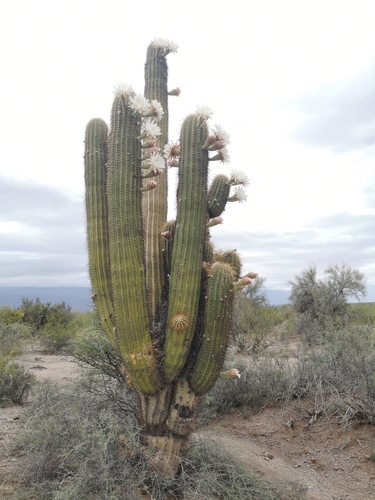
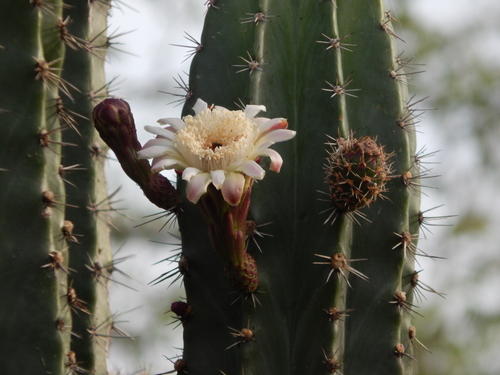
Stenocereus huastecorum is an organ pipe or candelabra-type cactus that grows up to 9 meters (around 30 feet) tall. Its stems and branches are cylindrical, with lengthwise furrows that form 8 to 10 ridges, each measuring 2.5 to 2.8 centimeters (a bit over 1 inch) high. Each ridge holds circular, pale gray spine-bearing structures called areoles, which are spaced 2 to 3 centimeters (around 0.8 to 1.2 inches) apart. The spines that grow from each areole come in two types: approximately 3 central spines that reach up to 4 centimeters (around 1.5 inches) long, growing more or less upward or outward from the cactus surface, and 10 to 11 radial spines that reach no more than 1 centimeter (around 0.4 inches) long, lying closer to the cactus body. Flowers of this cactus grow up to 10 centimeters (around 4 inches) long, and can open up to 5 centimeters (around 2 inches) across. The outer tepals of the flowers are green with a purple tint, while the inner tepals are white, sometimes with a light rose coloring. The fruits are spherical or egg-shaped, reaching up to 5 centimeters across, and are green with a red to purple hue. They are covered in spines that grow up to 1.5 centimeters (around 0.6 inch) long, and these spines detach when the fruit is fully ripe. Ripe fruits hold purple seed-containing pulp, with small black seeds. According to the 2018 publication that formally established this species, Stenocereus huastecorum is endemic only to Mexico. It grows primarily in the physiographic regions of the mountainous Sierra Madre Oriental and the Northeastern Coastal Plain, in southern Tamaulipas, eastern San Luis Potosí, northern Querétaro, and eastern Guanajuato. There is also a separated disjunct population on the southern slopes of the Trans-Mexican Volcanic Belt in the state of Veracruz. A Mexican government webpage notes that in Mexico, pitaya fruits like those of Stenocereus huastecorum are used to make a range of edible products, including juices, ice cream, atole, yogurt, cakes, jellies, liqueurs, sparkling wines, syrups, and jams. Laboratory studies have found that the fruits of this species have antioxidant effects, which may be linked to the high betalain content found in the fruit juice. As any search for the name Stenocereus huastecorum online will show, its seeds and living plants are sold commercially under common names including pitaya and Huasteca organ pipe. Gardeners value these plants for their tall, eye-catching growth habit, and in 2025 one Facebook merchant priced them at $15 per foot.