About Stenocereus griseus (Haw.) Buxb.
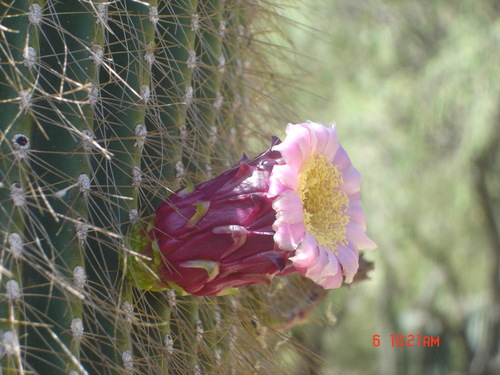
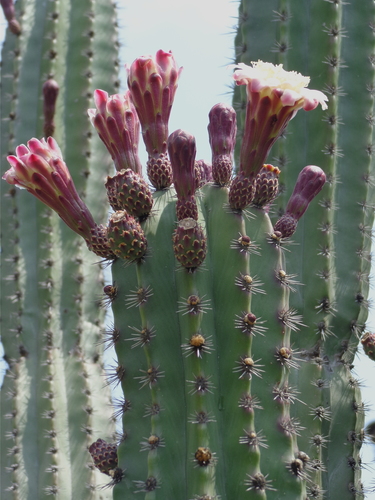
Stenocereus griseus (Haw.) Buxb. is a tree-shaped cactus that grows 6 to 9 meters tall, with a distinct clear trunk and upright green stems. Stems measure around 9 to 12 centimeters in diameter, and have six to ten ribs located below the areoles. This cactus produces one to three central spines that grow up to 1.5 centimeters long, with the longest central spine reaching 4 centimeters. It also grows six to eleven marginal spines that measure 6 to 10 millimeters in length. This species forms white, funnel-shaped flowers that open at night and remain blooming until midday. The flowers have bent-back flower bracts, and are roughly 10 centimeters long. Its fruits are spherical to elongated, and range in color from white or yellowish green to red or dark purple. Fruits grow up to 5 centimeters in diameter, are covered in thorns that shed once the fruit is ripe, and have red flesh. This species is distributed in Oaxaca and Veracruz (Mexico), coastal Venezuela, the Guajira Peninsula of Colombia, and the ABC islands of the Dutch Caribbean. It grows in scrublands. Observations of this species have been reported in dry scrublands at the base of the Eastern Cordillera of the Colombian Andes, though no specimens have been collected from this region. On the Caribbean ABC islands of Aruba, Curaçao and Bonaire, this cactus blooms and fruits abundantly during the dry season, and acts as a critical resource for bats, birds, and other animals. For human use, its fruit is edible for people and is considered to have a good flavor. It is planted as an ornamental plant and as a living fence in warm regions. When used as a living fence, its spiny growth makes it impervious to animals.