About Stenocereus eruca (Brandegee) A.C.Gibson & K.E.Horak
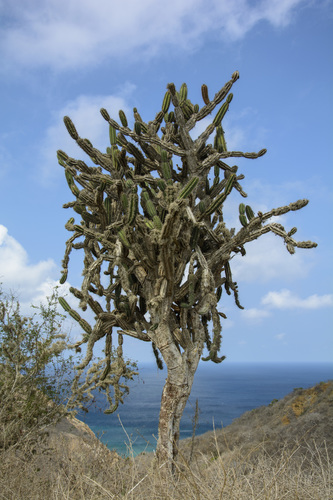
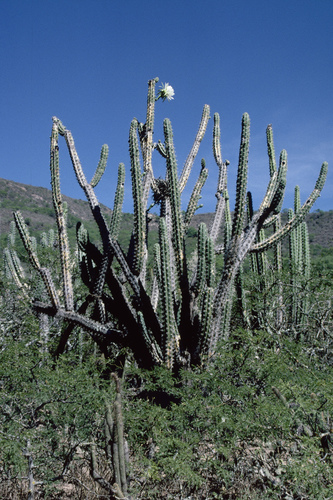
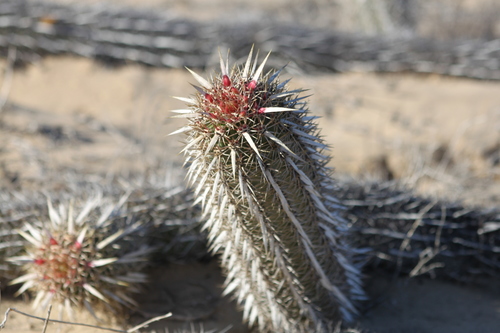
Commonly called creeping devil, Stenocereus eruca is a succulent cactus reported to contain mescaline and sterols. Its growth pattern can take the form of widely scattered individual stems, and in favorable locations it can form impenetrable patches of branching stems several meters across. It is often forms large mats, with a recumbent, columnar growth habit where only the terminal end of the stem is lifted slightly upward from the ground, resulting in a typical overall height of only 20 to 30 cm. The stem itself is very spiny, ranges in color from gray-green to creamy green, and averages 5 cm in diameter and 1.5 to 2 m long. This cactus has 10 to 12 ribs. It produces 4 to 6 strong, flattened, dagger-like grayish central spines, plus 10 to 17 whitish, somewhat rounded radial spines that vary in length and measure 10 to 15 mm long. Its nocturnal flowers are long, and shaped either like a tube or a peduncle; they come in white, pink, or yellow, are typically 10 to 14 cm long, have a spiny ovary, and flower sparingly in response to rain. Its fruits are round, red, covered in thorns, 3 to 4 cm long, and contain black seeds. Creeping devil grows along the ground: one end of the stem continues growing while the other end slowly dies, and new adventitious roots develop successively along the underside of the stem. Its growth rate is adapted to the moderate, moist marine environment of the Baja peninsula, where it can grow over 60 cm per year. When transplanted to a hot, arid environment, however, it may grow as little as 60 cm per decade. Over many years, the entire cactus moves slowly across the ground: stems branch and take root near the growing tips, while older portions of the stem die and disintegrate. This traveling chain of growth gives the species its scientific epithet eruca, meaning "caterpillar", as well as its common name creeping devil. Stenocereus eruca has been described as "the most extreme case of clonal propagation in the cactus family" (Gibson and Nobel, 1986). Because of its isolated range and scarcity of pollinators, the plant reproduces by cloning itself: pieces detach from the main stem when their bases die and rot. This species is endemic to the Magdalena Plains on the central Pacific coast of Baja California Sur, where it occurs at altitudes up to 20 meters, grows only in sandy soils, and forms massive colonies. Two other species of the Stenocereus genus found on the Baja Peninsula are Stenocereus thurberi (Organ Pipe Cactus, Pitaya Dulce) and Stenocereus gummosus (Sour Pitaya, Pitaya Agria, Pitayha). While this cactus was once thought to be threatened with extinction, further evidence has shown that it is not. Transplantation is not recommended due to this species' specialized environmental requirements, but it can be successful if conditions that closely match its native habitat are strictly maintained.