About Steatoda grossa (C.L.Koch, 1838)
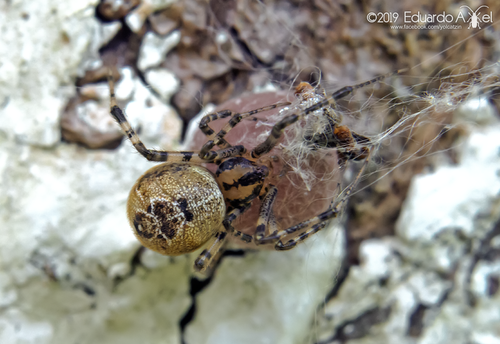
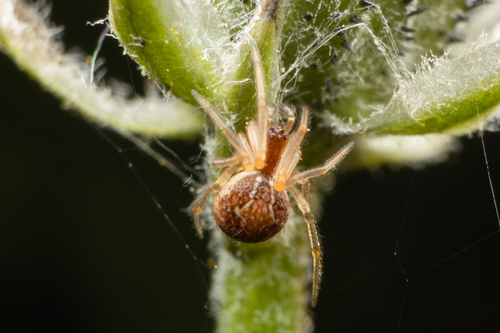
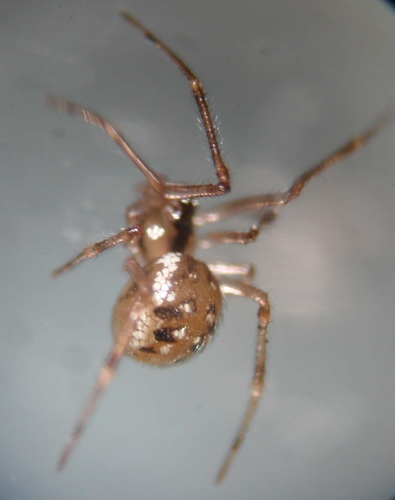
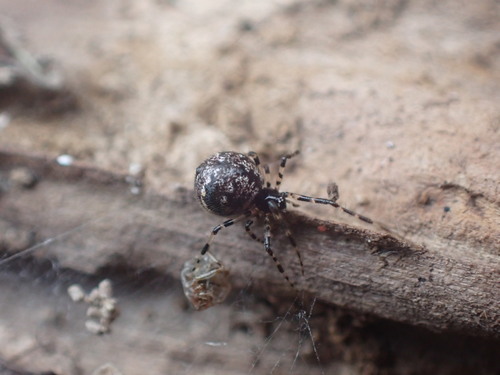
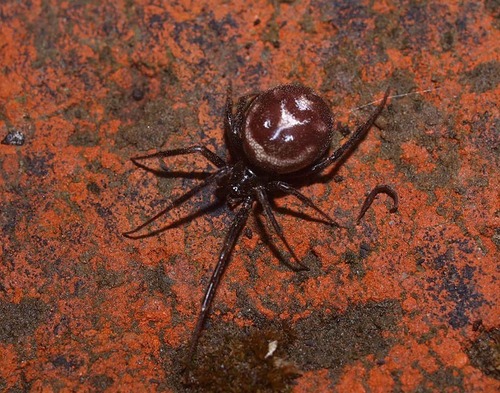
Like black widows, female Steatoda grossa are 6 to 10.5 millimeters long, dark-colored, and have a round, bulbous abdomen. Their typical coloration ranges from purplish brown to black, with light-colored markings. Unlike black widows, redbacks, and other species in the Latrodectus genus, S. grossa does not have a bright red hourglass pattern or any other bright, distinctive markings. Like many spider species, male S. grossa are sometimes smaller than females, but they can often be nearly as long as females. Males measure 4.1 to 10.0 millimeters in length and have thinner bodies than females. The two sexes share similar coloration; however, sexually mature males almost always have lighter, more reddish legs than females. S. grossa spiders may molt up to six times (through instar stages) before reaching maturity. According to Charles Hogue in his 1993 work Insects of the Los Angeles Basin, S. grossa reportedly preys on black widows. They can survive for several months without feeding as long as they have access to water. A well-fed female can produce three or more egg sacs each year. Each egg sac typically holds between 40 and 100 eggs. Once the eggs begin to change color and approach hatching, the mother can often be observed guarding her eggs for hours, or even days, at a time. At normal household temperature and humidity, eggs usually hatch within one month of being laid. Spiderlings are independent immediately after hatching. Female S. grossa can live up to six years, while males typically have a lifespan of 1 to 1.5 years. Males often die shortly after mating. Steatoda grossa is a cosmopolitan species. It is native to Europe and most of temperate Asia. It has been introduced to North America, South America, Macaronesia, Africa, New Zealand, and Hawaii. In South Africa, specimens of this species have been collected from the Grassland, Fynbos, Nama Karoo, and Savanna biomes.