About Stanleya pinnata (Pursh) Britton
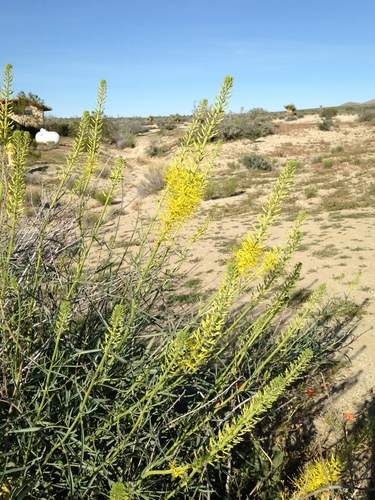
Stanleya pinnata (Pursh) Britton is a perennial herb or shrub that grows multiple erect unbranched, hairless stems, which often have a waxy texture and woody bases. Stems reach a maximum height of around 1.5 metres. Its leaves have fleshy blades borne on petioles; blades can grow up to 15 centimetres long and 5 centimetres wide, and are divided into several long, narrow lobes. The upper portion of the stem holds a long inflorescence: a dense raceme containing many flowers. Each flower has four narrow yellowish sepals that open to reveal four bright yellow petals, each up to 2 centimetres long. Stamens protruding from the flower's center can grow nearly 3 centimetres in length. The fruit is a curving, wormlike silique that reaches up to 8 centimetres long. This species is native to the western Great Plains and western North America. It grows in many types of open habitat, including deserts, chaparral, foothills, rocky cliffs, sagebrush, and prairie, and it favors soils rich in alkali and gypsum. It acts as a larval host for the caterpillars of both Becker's white and checkered white butterflies. Some of this plant's amino acids incorporate soil selenium in place of sulfur, making the plant highly toxic to animals. It has been used as a traditional medicinal plant and food source by multiple Native American groups, including the Hopi, Zuni, Paiute, Navajo, Kawaiisu, and Tewa peoples.