About Stachys stebbinsii G.A.Mulligan & D.B.Munro
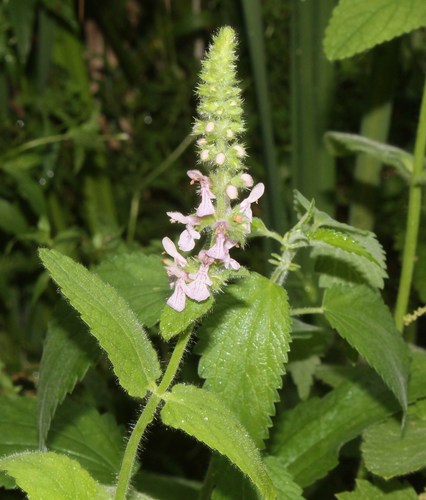
Stachys stebbinsii is a rhizomatous perennial herb. Its lower leaves, upper stems, and calyx are abundantly covered in dense, yellowish, sticky, mostly glandular hairs that give off a strong musky odor. This species can be distinguished from the related Stachys rigida and Stachys ajugoides by the size of its corolla lower lip, its strong musky odor, its cordate leaf shape, and the dense glandular hairs covering its stem. Its white, fleshy rhizomes measure 5 to 10 mm (0.20 to 0.39 in) thick. Its stems are erect, robust in growth habit, covered in sticky resin, and can reach up to 1.5 m (4.9 ft) tall. Leaf petioles grow 5 to 6 cm (2.0 to 2.4 in) long. Mature leaves measure 10 to 12 cm (3.9 to 4.7 in) long by 4 to 5 cm (1.6 to 2.0 in) wide; they range in shape from broadly lanceolate to narrowly cordate, with an acute tip. The base of the leaf ranges from truncate to strongly cordate, and leaf margins have a distinct scalloped edge. Flowers are arranged in 6-flowered clusters that form the plant's inflorescence. On each flower, the calyx tube is 4 to 5 mm (0.16 to 0.20 in) long, with individual calyx lobes measuring 2.5 to 3 mm (0.098 to 0.118 in) long. The corolla ranges in color from whitish and pale pink to pink, measures 8 to 9 mm (0.31 to 0.35 in) long, and has a labiate structure: it has a small upper lip, and a much larger lower lip that measures 7.5 to 8.5 mm (0.30 to 0.33 in) long by 6 to 10 mm (0.24 to 0.39 in) wide. Mature seeds are dark brown to black, and measure 2 mm (0.079 in) by 1.5 mm (0.059 in).
Stachys stebbinsii is native to western California (United States) and Baja California (Mexico). In California, it occurs from the San Francisco Bay area south all the way to San Diego County. Localities noted in the species' original type description include Lake Merced, areas within Napa County, Berry Canyon in Butte County, San Luis Obispo, the Santa Ana River, the Santa Ana Mountains in Orange County, the San Jacinto Mountains, Elsinore in Riverside County, and San Diego County. In Baja California, the species is rare from Tijuana south to El Rosario, but it is most abundant in the Sierra de San Pedro Martir.
Stachys stebbinsii most often grows in moist or wet environments across a variety of habitat types. These habitats include areas along watercourses, near wetlands and waterbodies, and in roadside ditches. In Baja California, it can also be found growing in coastal sage scrub, chaparral, and the varied environments of the California Floristic Province portion of the Peninsular Ranges. Across its range, Stachys stebbinsii is most commonly associated with humus and seepage soils, but it will also grow on sand, gravel, or other substrates as long as plentiful moisture is available.