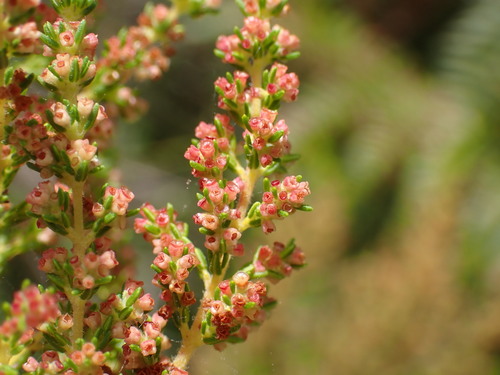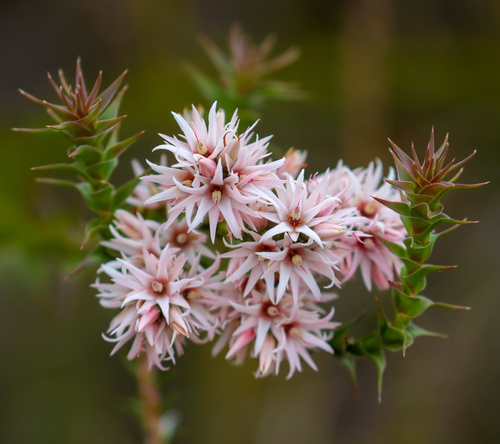
About Sprengelia incarnata Sm.
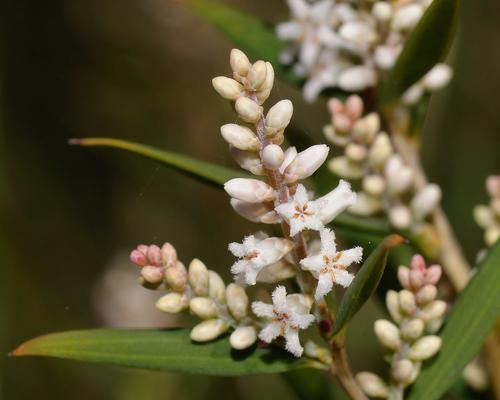
Sprengelia incarnata Sm. is an erect, hairless shrub that typically grows 0.5 to 2 metres (1 ft 8 in to 6 ft 7 in) tall, and has reddish-brown to red stems. Its leaves are egg-shaped to lance-shaped, 3 to 20 millimetres (0.12 to 0.79 in) long and 2 to 6 millimetres (0.079 to 0.236 in) wide, with a base that clasps the stem and a sharp point 0.4 to 0.7 millimetres (0.016 to 0.028 in) long at the tip. Flowers are arranged in clusters of 3 to 20, forming spikes 7 to 20 millimetres (0.28 to 0.79 in) long near the ends of stems, with bracts and bracteoles 5 to 10 millimetres (0.20 to 0.39 in) long at the base of each spike. The sepals are usually pink, narrowly triangular to lance-shaped, and 3.8 to 5.5 millimetres (0.15 to 0.22 in) long; the petals are also usually pink, joined at the base to form a tube 0.5 to 1.3 millimetres (0.020 to 0.051 in) long, with spreading, narrowly triangular lobes 3 to 5 millimetres (0.12 to 0.20 in) long. Flowering occurs mainly from June to either October or December, and the fruit is a capsule 2 to 3 millimetres (0.079 to 0.118 in) long. The Tasmanian endemic species Richea sprengelioides and Richea procera are similar in appearance, but they have leaf scars on their stems that are not present on the smooth stems of S. incarnata. This species is native to Australia and New Zealand, where it grows in wet swamps and heathlands. In Australia, it occurs across many south-eastern regions: it is only found in the far south-east of South Australia, including Kangaroo Island, the southern half of Victoria, and the coast and nearby tablelands of New South Wales south of Coffs Harbour. Pink swamp-heath, the common name for this species, is widespread and abundant in Tasmania, where it grows in almost all wet and peaty landscapes, ranging from sea level to the state’s highest mountains. In New Zealand, it is considered naturally uncommon and at high risk, and is only found in Fiordland National Park and on Resolution Island.