About Sporophila corvina (P.L.Sclater, 1860)
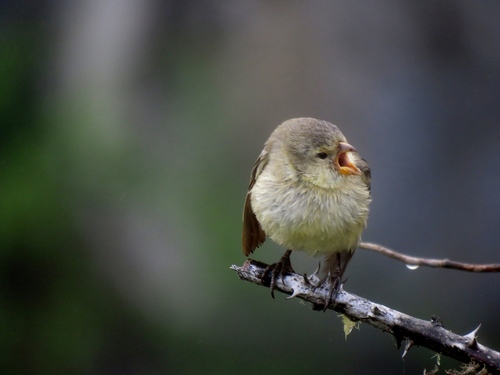
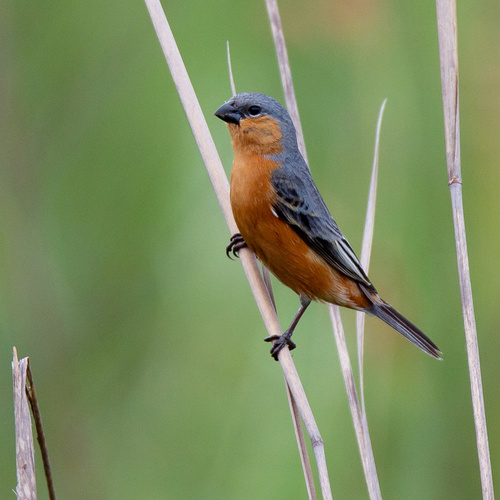
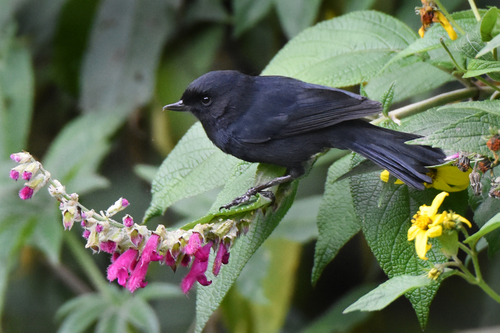
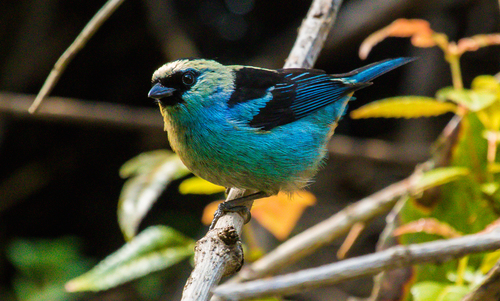
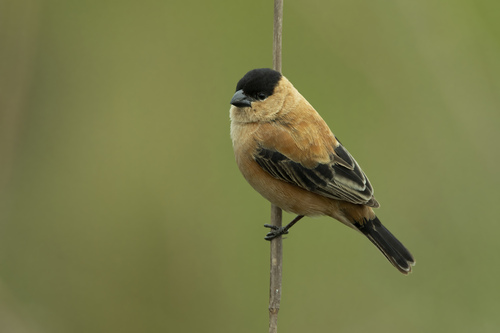
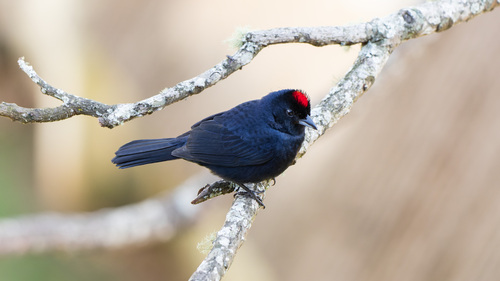
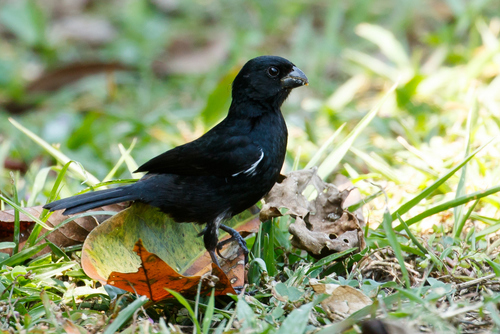
The variable seedeater (Sporophila corvina) is a small, robust bird with a black conical bill. It measures 10.5 cm (4.1 in) long and weighs 11 g (0.39 oz). It has four recognized subspecies that differ primarily in male plumage: the nominate subspecies S. c. corvina, first described by P.L. Sclater in 1860, occurs from southern Mexico, along the Caribbean slope from Belize south to Panama. Adult males of this subspecies are entirely black except for a small white wing-speculum and white wing linings. S. c. hoffmannii, described by Cabanis in 1861, is found on the Pacific slope of Costa Rica and Panama. Males of this subspecies resemble S. c. corvina males, but have a white half-collar, white rump, and white belly; the rump is often mixed with grey, and the flanks still have some black mottling or barring. S. c. hicksii, described by Lawrence in 1865, is distributed in eastern Panama and adjacent north-western Colombia. Males look like S. c. hoffmannii males, but the entire throat is white, with only a small black chin and/or malar region. S. c. ophthalmica, described by P.L. Sclater in 1860, ranges across southwestern Colombia, western Ecuador, and far north-western Peru. Males are very similar to S. c. hicksii males, but the black malar stripe is very fine or absent, the rump is purer white, and the flanks are also purer white with little to no black mottling or barring. Previously, additional subspecies were recognized for the various hybrid populations that occur where these four subspecies meet, which is discussed further in Taxonomy. Females are olive-brown on their upperparts, paler on their underparts, and have white wing linings just like males. Racial differences in female plumage are minor: S. c. hoffmannii, S. c. hicksii, and S. c. ophthalmica are generally paler and less brown than S. c. corvina, and often have a faint yellow tinge on their underparts. Juveniles match the appearance of adult females of their subspecies. Males may not develop full adult plumage during their first year, and can breed while still displaying some immature physical features. A hypermelanic male was recorded at Reserva Buenaventura in El Oro Province, Ecuador, in 2005. This individual had increased phaeomelanin; all of its white areas except the wing areas were bright tawny chestnut. A similar individual was collected along the "Pipeline Road" near Gamboa, Panama, in 1963. These rare hypermelanic individuals are thought to offer insight into speciation processes: within the genera Sporophila and Oryzoborus, there are multiple pairs of species that only differ externally in that one has white plumage areas and the other is hypermelanic, just like the two recorded variable seedeaters. While there must be some factor that maintains reproductive isolation between these species pairs, the plumage differences between such pairs probably originated when a mutation like this became fixed in a founder population through genetic drift. In terms of ecology, the variable seedeater is a common to abundant bird that lives in lowlands and foothills up to 1,500 m (4,900 ft) in altitude, in semi-open habitats such as forest edges, roadsides, low scrub, and gardens. It forms mixed flocks with other seedeater species in pastures, weedy fields, and other grassland areas. This species feeds mainly on grass seeds, but also consumes other seeds, berries, and some insects. The female builds a flimsy cup nest from coarse plant material, lined with a small amount of finer fibres. The nest is placed in the fork of a tree twig, 0.4 to 6 m (1.3 to 19.7 ft) above the ground, and occasionally sits higher. The clutch consists of two or three pale grey eggs with brown speckles, which are incubated solely by the female for 12–14 days until hatching. The variable seedeater produces a harsh chur call. The male's song is a mix of warbles, whistles, and twitters, and is more elaborate among populations on the Pacific slope.