About Sporobolus pumilus (Roth) P.M.Peterson & Saarela
Sporobolus pumilus, commonly called saltmeadow cordgrass and also known as salt hay, is a cordgrass species native to the Atlantic coast of the Americas. Its native range extends from Newfoundland south along the eastern United States to the Caribbean and northeastern Mexico. It received its current scientific name after a 2014 taxonomic revision, but its older name, Spartina patens, is still commonly used. As an introduced species, it occurs in marshlands across other parts of the world, where it often acts as a harmful noxious or invasive weed.
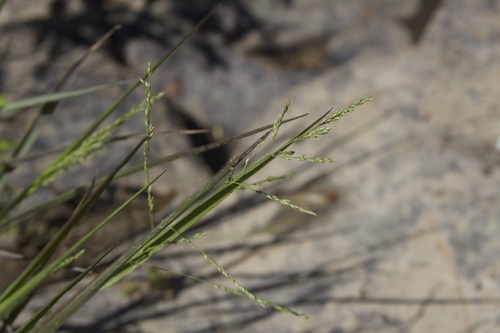
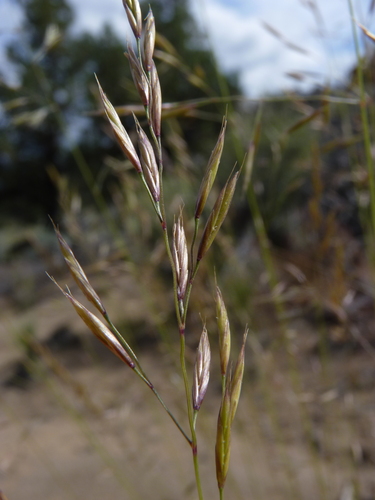
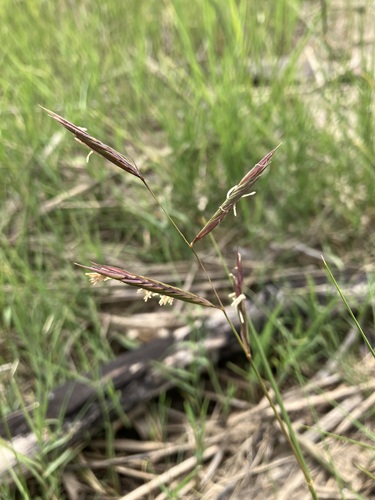
This species is a perennial grass that grows in the upper zones of brackish coastal salt marshes. It is a slender, wiry plant that forms thick mats growing 30 to 60 centimeters (12 to 24 inches) tall. Foliage is green during spring and summer, and turns light brown in late fall and winter. Its stems are wispy and hollow, and its leaves roll inward to give a rounded appearance. Weak stems allow wind and water to bend the grass, creating a landscape of tufts and cowlicks. Like its relative smooth cordgrass, saltmeadow cordgrass produces flowers and seeds only on one side of the stalk. Its flowers are deep purple from June to October, and turn brown during the winter.
Saltmeadow cordgrass grows in high marsh zones that are occasionally covered by high tides. Specialized cells in the plant exclude salt from entering its roots, which prevents the loss of fresh water. It is less tolerant of saltwater than many other marsh grasses, but can also grow on beaches and quickly recolonize overwash zones.
A healthy salt marsh depends on the presence of plants such as salt hay and smooth cordgrass. These grasses provide rich habitat for crustaceans, mollusks, and birds, and act as a major source of organic nutrients for the entire estuary. Mats of saltmeadow cordgrass host many small animals, and are an important food source for ducks and seaside sparrows. Saltmeadow cordgrass marshes also function as pollution filters, and buffer shorelines against flooding and erosion.
During the colonial era, settlements from Narragansett Bay to the Gulf of Maine were often established near salt marshes, because saltmeadow cordgrass was valued as fodder. It was harvested to use as bedding and feed for farm animals, and as mulch for gardens. Before hay was baled and stored under cover, saltmeadow cordgrass was used to top outdoor hay stacks.
Many salt marshes in Rhode Island have been severely damaged by filling, development, and road construction. These changes restrict tidal flow, which often has severe negative ecological impacts on the marsh. Because saltmeadow cordgrass requires a salty, wet habitat, restricted tidal flow often dries out the marsh and encourages invasive freshwater plants to grow. In areas where human activity has disturbed or altered the marsh, saltmeadow cordgrass and smooth cordgrass are often outcompeted for space by common reed. Common reed is less productive and less beneficial to salt marshes than native cordgrass.
While it is a key member of salt marsh plant communities in its native range, saltmeadow cordgrass is a harmful invasive species in other parts of the world. It is a notorious pest in the San Francisco Bay Area, where it outcompetes native plants such as soft bird's beak and changes the habitat of rare animals such as Ridgway's rail. This cordgrass was introduced to Oregon's estuaries via oyster shipments, and has come to dominate the area, crowding out native vegetation. It has also been recorded in marshes on the Iberian Peninsula, where it threatens native plant biodiversity.