About Spondias purpurea L.
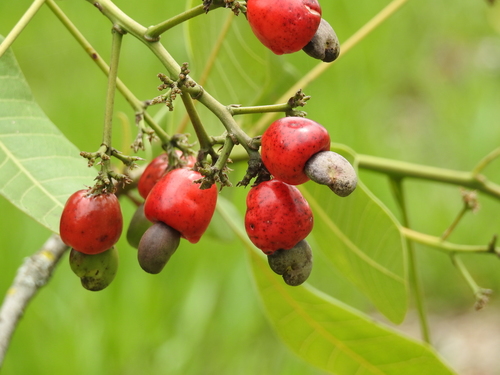
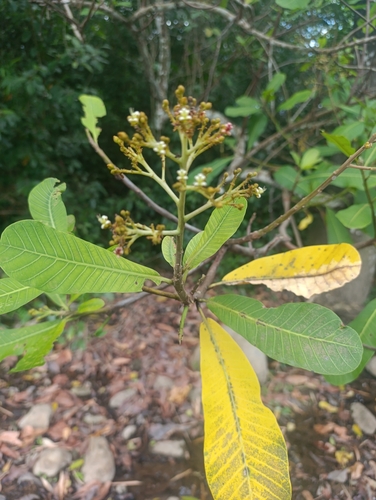
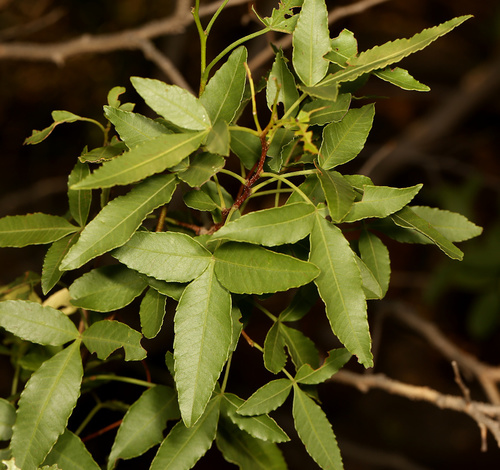
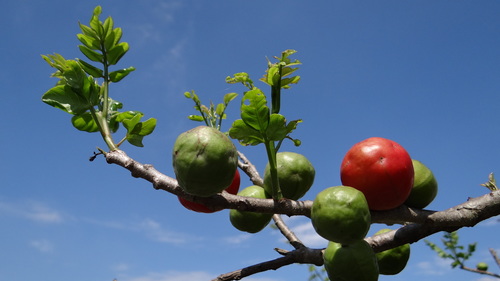
Spondias purpurea L. produces fruit that grows on deciduous trees adapted to warm tropical climates. Fruit development begins after the tree produces small red flowers, which emerge before any leaves appear on the tree. Fruit grows along thick, knobby branches, either in clusters or singly. The fruit is between 2.5 and 5 centimeters in diameter, with a slightly elongated shape. Some fruit have a knob at one end, or an otherwise irregular shape. Young fruit are green or yellowish-green, and ripen to purple or red; some variants of the species ripen to a yellow color instead. The fruit has a thin, waxy-looking edible skin. When ripe, the inner pulp is yellow and sweet. At the center of the fruit is a large, inedible stone pit. The flavor of S. purpurea fruit is often compared to plum: it is sweet, with a slight acidic aftertaste. Fruit of this species is available during fall and winter months. S. purpurea fruit is rich in vitamin C and carbohydrates. It is a source of calcium, phosphorus, and iron, and contains a small amount of fiber. It also contains carotene, B-complex vitamins, and several important amino acids. The fruit is high in antioxidants that help the body eliminate free radicals. Urushiol is present in the tree's sap, and in small concentrations in the fruit peel. This compound can trigger contact dermatitis in sensitized individuals. This reaction is more likely to affect people who have not been exposed to other plants from the Anacardiaceae family, such as poison oak and poison ivy, which are widespread across the United States. In Florida, this tree can only grow in the state's near-tropical areas. North of Palm Beach County, cold winter temperatures kill or severely damage the tree. Most often, S. purpurea fruit is eaten raw, when fully ripe. Ripe fruit are soft to the touch and very sweet. They are eaten similarly to plums or mangoes: the pulp is consumed, and the large inedible stone is discarded. The pulp can also be processed to make beverages, by mashing it and mixing it with water and a sweetener. Whole fruits can be boiled in water with sugar, and sometimes other fruits, to make a syrup or "honey", which is eaten on its own as a dessert or served with ice cream. Whole fruits can also be cooked to make preserves, with the seeds strained out of the final product. Boiling and drying S. purpurea fruit preserves it for several months. A traditional jocote dish from Salvadoran cuisine uses a syrup made from panela, an artisan molasses produced by boiling sugarcane juice to evaporate excess water until it reaches a thick molasses consistency. The liquid is then poured into wood molds to cool and solidify, and the finished blocks are wrapped in dry corn husk leaves called tuzas before being sold in markets. This dish is only available during harvest season, which runs from around Easter to the end of August. Unripe fruits can be eaten, but they are much tarter and somewhat bitter. In Costa Rica and Ecuador, it is customary to eat unripe S. purpurea fruit with salt. Unripe fruit can also be made into a tart sauce, or pickled in vinegar or lime juice, then served with chile peppers and salt. Both ripe and unripe fruit are commonly sold street-side in plastic bags across most Central American countries; vendors often also sell red hot pepper sauce and alhuaishte, a product made from very finely ground toasted pumpkin seeds. In Costa Rica, Panama, and coastal Ecuador, this tree is commonly planted throughout the countryside to act as a living fence, and can be easily propagated by planting cut tree trunks. Jocotes are native to the central tropical regions of the Americas. Wild populations are found in Belize, Colombia, Costa Rica, El Salvador, Guatemala, Honduras, Jamaica, Mexico, Nicaragua, and Panama. The species has been introduced and naturalized in other parts of the Americas, including the Bahamas, Bolivia, Cayman Islands, Cuba, Dominican Republic, Florida, French Guiana, Guyana, Haiti, Leeward Islands, Peru, Puerto Rico, Trinidad and Tobago, Venezuela, and the Windward Islands. It was introduced to tropical Asia via the Philippines, and now grows in Java (Indonesia) and Bangladesh. It has also been introduced to West Africa, where it grows in Gambia, Guinea-Bissau, and Senegal.