About Spondias dulcis Parkinson
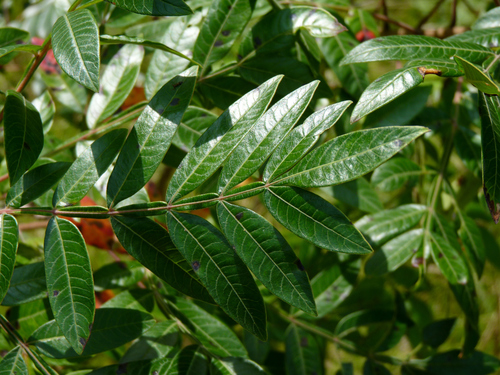
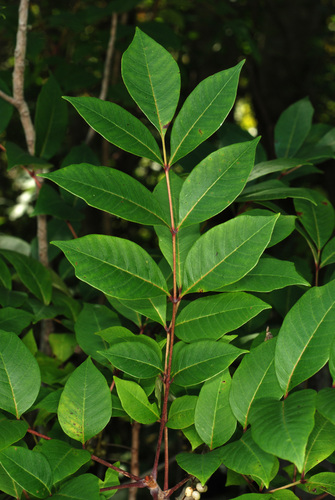
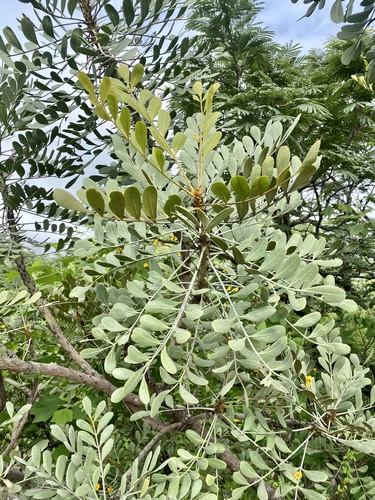
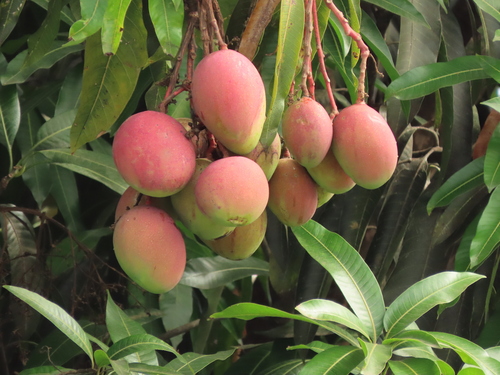
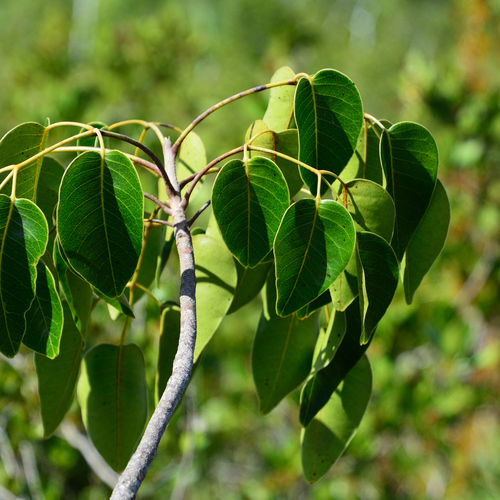
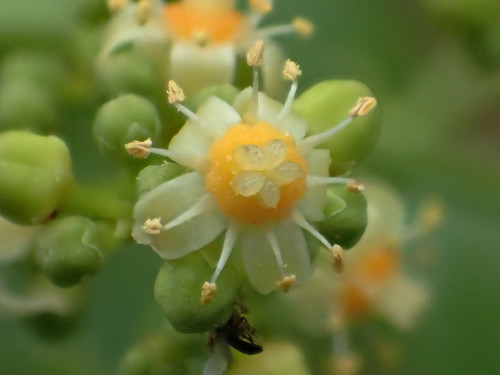
Spondias dulcis Parkinson is a fast-growing tree that reaches up to 20 m (66 ft) in its native range of Southeast Asia, Melanesia, and Polynesia; in areas outside its native range, it typically grows to an average of 10–12 m (30–40 ft). This tree has deciduous, pinnate leaves that are 20–60 cm (8–24 in) long, made up of 9 to 25 glossy, elliptic or obovate-oblong leaflets. Each leaflet is 9–10 cm (3.5–3.9 in) long, and has fine teeth along its edge near the tip. The tree produces small, unnoticeable white flowers that grow in terminal panicles. Its oval fruits are 6–9 cm (2.4–3.5 in) long, and grow in bunches of 12 or more on a long stalk. Fruits fall to the ground while still green and hard, then ripen over several weeks and turn golden-yellow. According to a 1987 account by Morton, some fruits grown in the South Sea Islands weigh over 500 g (1 lb) each. From the time of planting, Spondias dulcis takes 4–6 years to produce its first harvest, has a productive lifespan of 20–30 years, and can fruit almost year-round. It is primarily propagated by cuttings or marcotting. Spondias dulcis is native to the coastal areas of Melanesia and Southeast Asia, specifically to modern-day Indonesia and Malaysia. It has been introduced to tropical regions across the world. It was brought to Jamaica in 1782, and is currently cultivated in Panama, Cuba, Haiti, the Dominican Republic, Puerto Rico, Suriname, Brazil, Costa Rica, Grenada, Trinidad and Tobago, Barbados, St. Lucia, and eastern Sucre in Venezuela. The United States Department of Agriculture received seeds of this tree from Liberia in 1909, but it never became a popular crop in the United States. Even so, it is grown in South Florida as far north as Palm Beach County. The fruit is also widely grown in Somalia's agriculture belt, and was likely introduced there during the colonial period before 1960. Spondias dulcis is most often used as a food source. In West Java, its young leaves are used as a seasoning for pepes. In Costa Rica, more mature leaves are eaten as a tart salad green, though the tree is most commonly valued for its fruit. The fruit can be eaten raw; its flesh is crunchy and slightly sour. According to a 2006 account by Boning, the fruit is at its best when fully colored but still somewhat crunchy. At this stage, it has a flavor between pineapple and mango. Its flesh is golden in color, very juicy, vaguely sweet, and has a slight hint of tart acidity. In Indonesia and Malaysia, the fruit is eaten with shrimp paste, a thick, black, salty-sweet sauce called hayko in the Southern Min dialect of Chinese. It is an ingredient in rujak in Indonesia and rojak in Malaysia. The juice of the fruit goes by different names across regions: it is called kedondong in Indonesia, amra in Malaysia, balonglong in Singapore, and gway thee in Myanmar. The fruit is also used to make preserves and flavorings for sauces, soups, braised dishes, and stews. In Fiji, it is made into jam, and its leaves are used to add flavor to meat. In Samoa and Tonga, it is used to make otai. In Sri Lanka, the fruit is soaked in vinegar with chili and other spices to make acharu. In Vietnam, unripe fruit is eaten with salt, sugar, and chili, or with shrimp paste. Children there eat the fruit macerated in artificially sweetened licorice extract. In Jamaica, the fruit is mostly considered a novelty, especially among children. It can be eaten with salt or made into a drink sweetened with sugar and spiced with ginger. In Barbados, ripe fruit is eaten plain, sprinkled with a small amount of salt, or dipped in naturally slightly salty ocean water while at the beach. It is also used to make juice in Grenada and Saint Lucia. In Trinidad and Tobago, it is prepared curried, sweetened, salted, or seasoned with pepper sauce and spices. In Cambodia, it is used to make a salad called nhoam mkak (/ɲŏam məkaʔ/ ញាំម្កាក់). In Suriname and Guyana, the fruit is dried and made into a spicy chutney, mixed with garlic and peppers. In Thai cuisine, both the fruits and the tender young leaves are eaten.