About Spodoptera frugiperda J.E.Smith, 1797
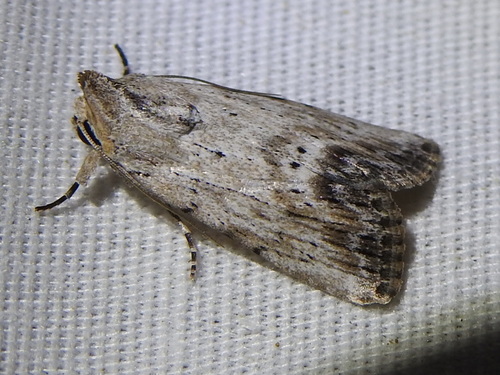
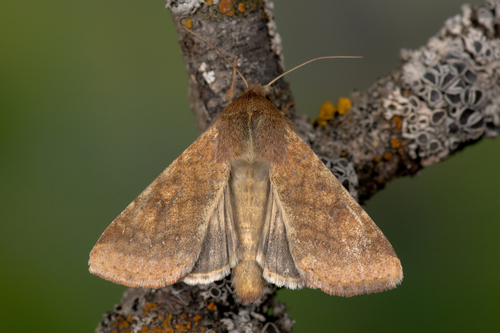
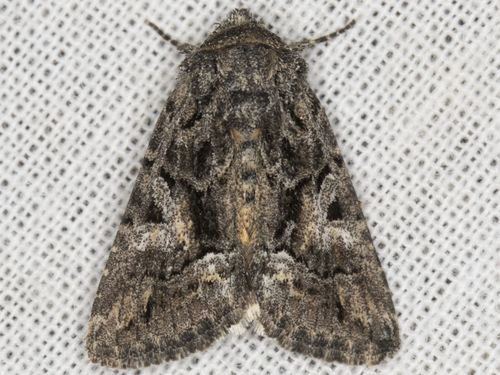
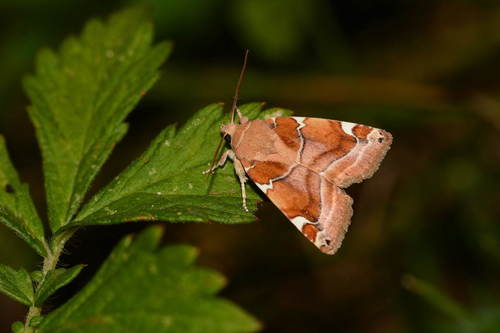
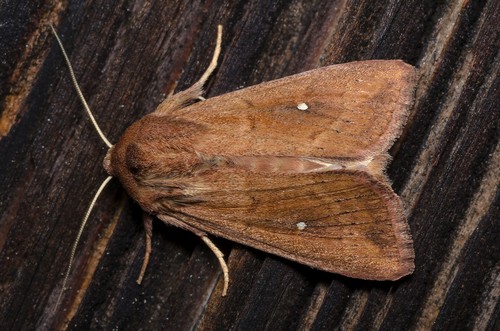
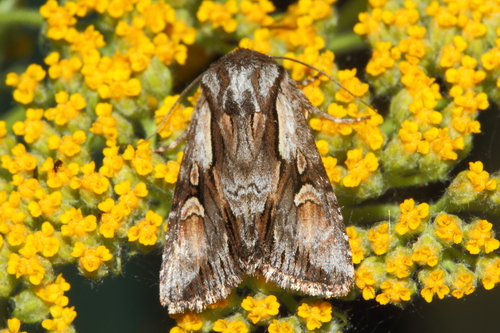
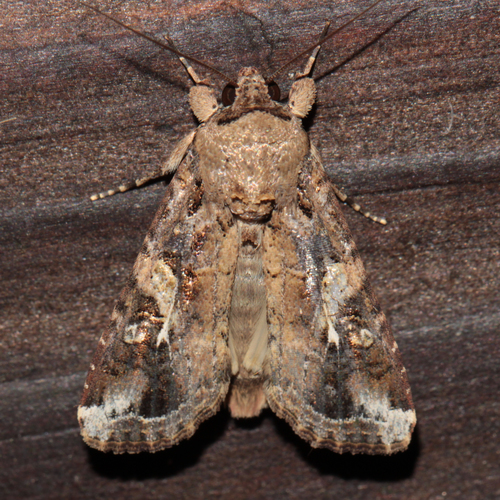
Spodoptera frugiperda, the fall armyworm, has adult moths with a wingspan measuring 32 to 40 millimetres (1+1⁄4 to 1+1⁄2 inches). Their forewings are brown or gray, while their hindwings are white. The species shows slight sexual dimorphism: males have more wing patterns and a distinct white spot on each forewing. First instar larvae are light-colored with a larger dark head. As larvae progress through their developmental instars, they become browner and gain white lengthwise lines, as well as dark spots with spines. The native range of fall armyworm covers a wide area of eastern and central North America and all of South America. It cannot survive winters where temperatures drop below freezing, so it only overwinters in the southernmost regions of the United States, specifically Texas and Florida. This makes it a more prominent pest in southeastern U.S. states. Seasonally, however, it spreads across the eastern United States and as far north as southern Canada, to inhabit areas that have suitable food supplies. Researchers have used CLIMEX to model the potential global distribution of S. frugiperda. The resulting modelled potential distribution reflects the strong seasonal range dynamics the species experiences in North America. Much of the potential range in Europe, South Africa, China, and Australia consists of habitat that is only climatically suitable during warmer months. A more recent physiologically based population dynamics model was created to assess S. frugiperda's potential distribution in Europe. This model found that Mediterranean coastal areas of Southern Europe may be particularly suitable for the species to establish permanent populations. S. frugiperda cell lines, namely Sf9 and Sf21, are commonly used in biomedical research to produce recombinant proteins, with the help of insect-specific viruses called baculoviruses. The Novavax COVID-19 vaccine uses baculovirus-infected Sf9 cells to express the SARS-CoV-2 spike protein. For the 2025/2026 influenza season, Sanofi used fall armyworm cell lines and baculovirus to produce Supemtek TIVr, a trivalent influenza vaccine.