About Splachnum rubrum Hedw.
Nomenclature and Growth Substrate
Splachnum rubrum Hedw. forms tufts of varying density that grow on herbivore dung.
Gametophyte Stem and Leaf Clustering
Its gametophyte is green to yellow-green, with leaves clustered at the apex of a stem that typically measures 1.5 to 3.0 cm long.
Individual Leaf Morphology
Individual leaves are 5–7.5 mm long, shaped obovate or acuminated, and have a costa that disappears in the apical lamina. Leaf margins are coarsely toothed.
Sporophyte Conspicuousness
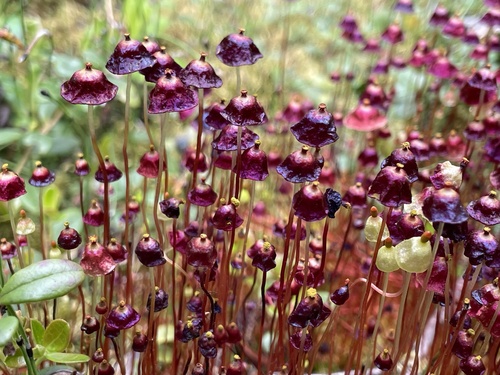
The sporophyte is the plant's most conspicuous part, and it is often mistaken for an angiosperm flower due to its shape and coloration.
Sporophyte Morphology
Its capsule is orange-brown, with a bright magenta, umbrella-shaped hypophysis, and it sits on a long, straight, orange-red seta that measures 5–13 cm long.
Sporophyte Development Timing
Splachnum rubrum develops its characteristic form in summer, when its sporangium matures.
Immature Sporophyte Similar Species
In spring, its immature sporophytes may be confused with mature sporophytes of Splachnum sphaericum or immature sporophytes of Splachnum ampullaceum.
Mature Species Distinction
When mature, this species can be easily distinguished from Splachnum luteum by its coloration.
General Habitat and Rarity
This species occurs mostly in swamps and muskeg, and it is very rare.
North American Distribution
It is the least common Splachnum species in North America, where it is found in boreal regions of Canada stretching from Newfoundland and Labrador to northern British Columbia and Alaska. A small number of specimens have also been observed in the Midwestern United States.
Eurasian Distribution
In Eurasia, it occurs in Northern Europe, Estonia, and Siberia.
Regional Conservation Status
It is classified as imperiled (S2) in Ontario and Alberta, and critically imperiled (S1) in Minnesota and Nova Scotia.
Specific Dung Substrate Preferences
Splachnum rubrum grows only on the dung of large herbivores; in North America it grows mainly on moose dung, while in Europe it also grows on cattle dung.
Moose Population Threat
In North America, S. rubrum is likely absent outside of the native moose range, so the decline of moose populations may further imperil this species.
Spore Dispersal Mechanism
S. rubrum is an entomophilous species, meaning it disperses its spores with the help of insects.
Dipteran Dung Attraction
Dipterans are attracted to the dung this moss grows on, as they use it as a site to find mates and lay eggs.
Spore Attachment Process
When a fly lands on the dung, it contacts mature capsules, and spores attach to the fly's body. The fly then carries these spores to another patch of dung, facilitating spore dispersal.
Primary Spore Disperser Taxa
The main spore dispersers are flies from the genera Scathophagaidae, Delia, Myospila and Pyrellia, which reproduce in early summer when S. rubrum's sporophytes mature.


