About Spizella breweri Cassin, 1856
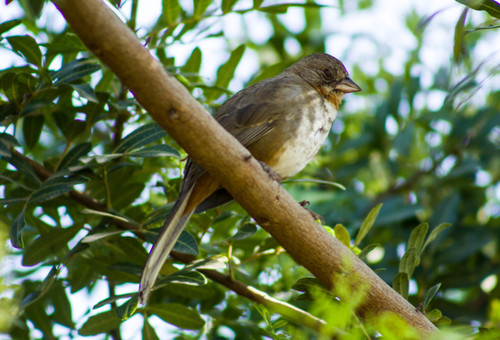
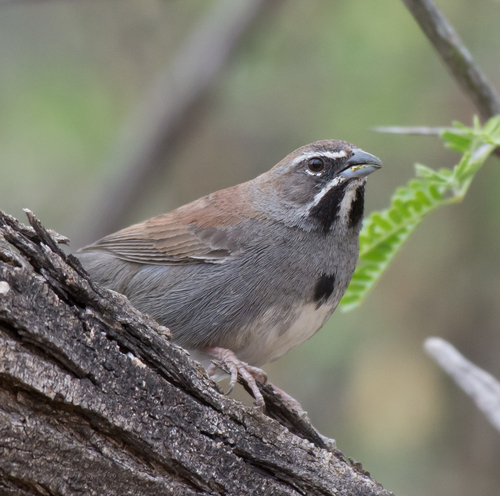
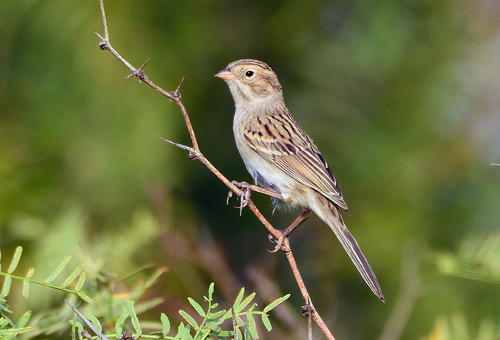
Scientific name: Spizella breweri Cassin, 1856, commonly called Brewer's sparrow. Adult Brewer's sparrows have grey-brown backs, speckled brown crowns, both marked with dark streaks, and a pale eye-ring. Their brown wings feature light wing bars, their underparts are pale grey, their bill is pale with a dark tip, and they have a long notched tail. They are similar in appearance to the closely related clay-colored sparrow (S. pallida), but lack the pale crown stripe and grey neck patch that the clay-colored sparrow has. Adult measurements are as follows: length 5.1–5.9 in (13–15 cm), weight 0.4–0.5 oz (11–14 g), and wingspan 7.1–7.9 in (18–20 cm). Males sing to defend their nesting territories. Their song is a long, varied mixture of notes and trills, and males produce two distinct song types classified as short and long. There are two recognized subspecies of Spizella breweri. The first is Brewer's sparrow proper, Spizella breweri breweri, which lives in brushy areas, especially areas with sagebrush, across southern parts of western Canada and the western United States. The second is the timberline sparrow, Spizella breweri taverneri, which inhabits thicketed areas around the tree line in the Rockies of British Columbia, Alberta, northern Montana, southern Yukon, and southeastern Alaska. Timberline sparrows are somewhat darker and larger than the southern nominate subspecies, and some authorities consider the timberline sparrow to be a separate species. In terms of migration and ecology, Brewer's sparrows migrate to the southwestern United States, ranging south as far as central Mexico. They forage primarily in shrubs or low vegetation, but also feed on the ground. During the summer, their diet consists mainly of insects; seeds become a more important part of their diet at other times of year. Outside of the breeding season, they typically forage in flocks, sometimes mixed with other sparrow species. The female usually lays three to four eggs, with a maximum of five, in a cup nest built in low shrubs. Brewer's sparrow populations have declined in some parts of the species' range. The causes of this decline are not well understood, but it is suspected that the loss of sagebrush habitat contributes at least partially to the trend. More research is urgently needed to understand resource use and limitation for this species during the wintering season. When the timberline sparrow was still recognized as a separate full species, the remaining Brewer's sparrow (sensu stricto) was classified as near threatened by the IUCN. However, the IUCN Red List only evaluates entire species for conservation status. After the two taxa were merged into a single species, the entire population of S. breweri is currently classified as a species of least concern.