About Spizella atrogularis (Cabanis, 1851)
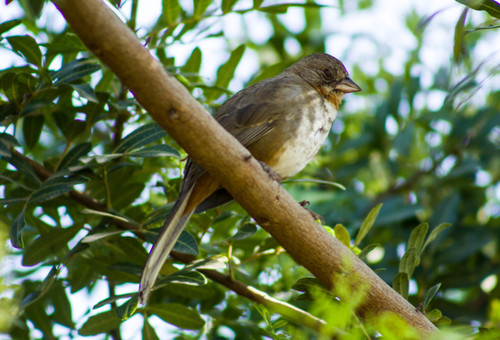
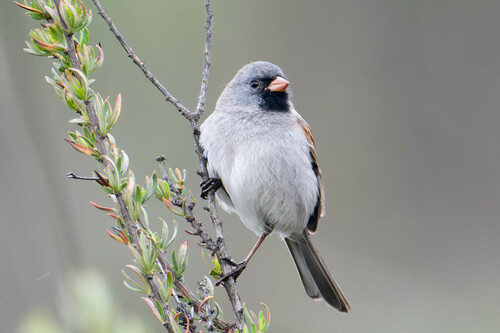
The black-chinned sparrow (Spizella atrogularis, originally described by Cabanis in 1851) is a small passerine bird. It measures 13 to 15 cm (5 to 5+3⁄4 inches) in length, with an approximate wingspan of 19 to 20 cm (7+3⁄4 inches). Its body mass ranges from 9.0 to 14.8 g (0.3 to 0.5 oz), with a median weight of 11.3 g (0.4 oz). Overall, it has a slender build and a round head with a high crown, plus a long, notched tail that is proportionately longer than the tails of other sparrows in the Spizella genus. Males and females have similar plumage, though males average slightly larger in size. Adult black-chinned sparrows have gray heads and bodies, with reddish-brown backs marked by black streaks. They have a poorly defined whitish belly, and their rumps and uppertail coverts are unstreaked gray. Feathers of the wings and tail are dark brown with paler edges, and these edges are white on tail feathers. During the breeding season, when males have alternate breeding plumage, they show extensive black coloring on their chin, throat, and the front of their face. Males lose most or all of this black outside the breeding season; only the oldest males may retain some black flecking year-round. Females have little to no black on their face, chin, or throat at any time of the year. In nonbreeding basic plumage, it can be difficult to distinguish males from females. Juvenile black-chinned sparrows resemble nonbreeding adults, but have faint indistinct streaking on their underparts and two faint wingbars. Their heads and underparts have a brownish wash, and their outer scapulars are tawny-colored. Their legs and feet are dark brown or dusky, and they have a small, stout, pink bill. Recently fledged black-chinned sparrows may have darker bills, noticeably short tails, yellow gapes, and paler gray heads. The black-chinned sparrow breeds in the southwestern United States and across most of Mexico north of the Isthmus of Tehuantepec. Its regular breeding range extends from northern California east to western Texas, and reaches as far north as southern Nevada and Utah; it has also been recorded as a vagrant or occasional breeder in Oregon and Colorado. This is a species of arid and semi-arid environments, where it inhabits chaparral, sagebrush, pine-juniper woodlands, and other brushy shrublands. Most of its habitat occurs in remote, rugged, rocky areas. It is notably less common in edge habitat, and rare near the coast. In the United States, it occurs at elevations from near sea level up to 2,400 m (8,000 ft), while in Mexico it is found between 300 and 2,500 m (980 to 8,200 ft). Some individual birds in Utah move into desert ecotones during post-breeding dispersal, and some northern populations move into Chihuahuan Desert scrub for the winter. Most northern populations migrate south for the winter, primarily to Mexico; many also move to lower elevations during this season. Black-chinned sparrows are sometimes recorded in montane oak forest during migration, but do not occur in mixed pine-oak forest during this time.