About Spizaetus ornatus (Daudin, 1800)
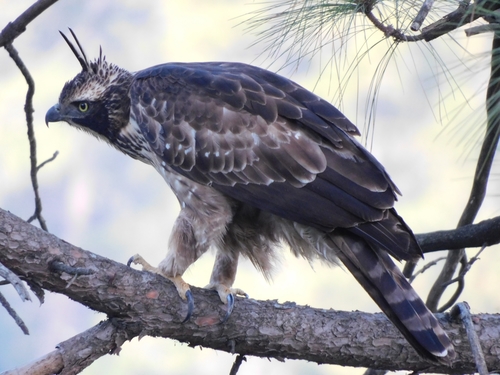
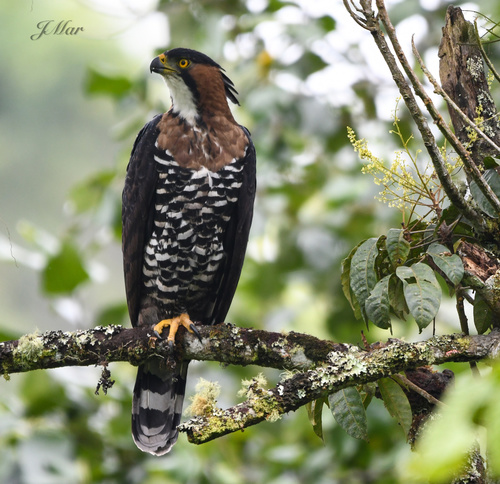
Spizaetus ornatus, the ornate hawk-eagle, is a medium-to-large raptor and a fairly small eagle. Like most birds of prey, it exhibits reverse sexual dimorphism: females are larger than males, which is the opposite pattern seen in most non-raptorial birds. The largest females are 13% larger than the largest males, with an average 8% size difference in the nominate race. In Central America, the largest females can be up to 50% heavier than the smallest males. This species is slightly smaller than the largest members of widespread raptor genera such as Buteo and Falco, but is usually larger than other forest raptors in its range, excluding vultures and other eagles. Full-grown ornate hawk-eagles measure 56.0 to 68.5 cm (22.0 to 27.0 in) in total length; the average length is 60 cm (24 in) for males and 63 cm (25 in) for females. Wingspan ranges from 117 to 142 cm (3 ft 10 in to 4 ft 8 in). Body mass ranges from 835 to 1,215 g (1.841 to 2.679 lb) in males and from 950 to 1,760 g (2.09 to 3.88 lb) in females. Two different samples of five adult males gave average weights of 1,009 g (2.224 lb) and 1,035 g (2.282 lb). Two samples of adult females gave average weights of 1,421 g (3.133 lb) for four individuals, and 1,452 g (3.201 lb) for 11 individuals. Standard measurements differ by sex and subspecies. For the nominate subspecies, wing chord measures 312 to 360 mm (12.3 to 14.2 in) in males and 320 to 405 mm (12.6 to 15.9 in) in females. For the subspecies S. o. vicarius, wing chord measures 337.8 to 349.3 mm (13.30 to 13.75 in) in males and 353.3 to 388 mm (13.91 to 15.28 in) in females. Tail length varies from 244 to 268 mm (9.6 to 10.6 in) in males and 266 to 290 mm (10.5 to 11.4 in) in females. The culmen (measured from the cere) is 25.5 to 29 mm (1.00 to 1.14 in) in males and 27 to 31.5 mm (1.06 to 1.24 in) in females. Tarsus length ranges from 87 to 92 mm (3.4 to 3.6 in) in males and 89.5 to 100 mm (3.52 to 3.94 in) in females. In a sample of S. o. vicarius from Guatemala, average wing chord was 339.8 mm (13.38 in) for 7 males and 377.8 mm (14.87 in) for 8 females. In the same sample, average tail length was 255.6 mm (10.06 in) for males and 281.6 mm (11.09 in) for females, and average tarsus length was 89 mm (3.5 in) for males and 94.1 mm (3.70 in) for females. Relative to its body size, the ornate hawk-eagle has a particularly enlarged largest rear talon (the hallux claw, the main killing tool for accipitrids). In Guatemala, this talon averages about 36.7 mm (1.44 in) in males and 39.1 mm (1.54 in) in females, and the average foot span for both sexes is around 13.5 cm (5.3 in). Ornate hawk-eagles mostly perch within the tree canopy, but will sometimes perch on exposed branches, especially early in the morning. Soaring activity usually peaks in the late morning. Brown & Amadon (1986) described this species as rather stolid and buteonine, despite its long tail and crest. Adult ornate hawk-eagles are easily identified by their rufous cowls, bold underside barring, and long erectile crest. The crest can lie flat against the head, stick straight up like a spike, or hang slightly curved. When perched, adults have a distinct black crown, black crest, and black malar stripes that extend as isolated streaks down the sides of the body. This pattern is contrasted by rufous color on the cheeks, ear-coverts, sides of the neck, and sides of the chest (sometimes covering the entire upper chest), which fades to a browner rufous on the nape. The upperside is barred blackish to dark brown, and usually has visible white tips on the mantle and lesser wing coverts. The underside has a whitish base color; apart from the often plain throat, it is boldly covered in black barring that extends down to the abdomen and legs, while the crissum has black spotting. Like many forest raptors, this species has relatively short wings and a fairly long tail. When perched, the wing tips reach slightly past the base of the tail. The tail is blackish with a creamy whitish tip and three broad pale bands, which are greyish on the upper side and whitish on the underside; the basal band is often obscured. Brown & Amadon noted that a perched ornate hawk-eagle appears to have legs set very far forward, almost under the chest, giving an impression of posed readiness, and the position of the black crest indicates the bird’s current temper. Juvenile ornate hawk-eagles differ noticeably from adults, and lack most of the adult pigmentation. Juveniles do not have the adult’s rufous collar, malar stripes, or underside barring. Instead, the entire head and underparts of a juvenile are white, with only thin black streaks on the crown and at the tip of the crest. Some juveniles do show variable, light dark brown barring and spotting on the flanks and thighs, and may even have a vestigial moustache on the face. The juvenile’s back and wings are dark brown, with blackish shoulders that have white tips. The juvenile tail is similar to the adult’s, but has a broader white tip and at least 4 to 5 thinner bands, which are also greyish above and whitish below. By their second year, young ornate hawk-eagles develop an intermediate or subadult plumage that quickly comes to resemble adult plumage, but appears more faded. The subadult face is sandy to pale rufous with an indistinct malar stripe, while barring and spotting gradually appear on the flanks, belly, and legs. The subadult back is still mostly dark brown, but becomes increasingly blackish. Adult ornate hawk-eagles have orangish-yellow eyes, a dull greenish to grey cere and bare lores, and rich cream to pale yellow feet. Juveniles have white to whitish-yellow eyes, a yellow to bluish-grey cere, and brighter yellow to orange feet. Juvenile legs are often less thickly feathered than adult legs. In flight, the ornate hawk-eagle appears intermediate in size: it is large compared to most forest raptors, but small and slender-bodied for an eagle. It has a prominent head and short, broad, rounded wings, with bulging secondaries and a pinch at the base of the trailing edges. Its flight is deep and powerful, with wings held somewhat flat and pressed slightly forward, and the tail may be closed or slightly spread. From above, adult flying birds have a rufous cowl, blackish mantle, and slightly brownish black back and wings, with white-tipped shoulders and tail coverts. From below, the underwing is paler than the body, with flecking or speckling only on the hand and thinly barred flight feathers. In flight, juvenile ornate hawk-eagles are mainly dark brown above, with whitish-scaled blackish-brown shoulders. From below, the juvenile wings have scattered spots on the axillaries and great wing-coverts, blackish tips on the white-based outer primaries, and thin barring on the other flight feathers, which sometimes matches the patterning of the tail. By the second year, there is only a moderate increase in flecks and spots on the wing linings, as flight feathers and the tail are the last features to molt from the juvenile pattern to the adult pattern. The ornate hawk-eagle has the largest distribution of the nine eagle species endemic to the Neotropics, with a total estimated range of 20.2 million square kilometers. It is mostly a sedentary species, though some local dispersal occurs, and individuals may wander into drier forest and higher altitudes than their typical habitat. Its range extends north to southeastern Mexico. In Mexico, it occurs on the Caribbean slope from southern Tamaulipas, and occurs more rarely on the Pacific slope in Jalisco and eastern Oaxaca. Its status in Colima is uncertain, and it may already be extirpated there. The species has been reported in Guerrero and Nayarit, but these records likely refer to wandering individuals. Nesting has not been confirmed anywhere in western Mexico, and most sightings there are of juveniles, suggesting these are post-dispersal wanderers. The species occurs almost continuously through Central America, in Belize, Guatemala, El Salvador, Honduras, and Nicaragua, continuing into Costa Rica and Panama, including the island of Coiba. In Panama, it is much more numerous on the more humid Caribbean side than on the drier Pacific slopes; it is especially scarce in the Panama Canal Zone and Azuero Peninsula, but can occur in more humid areas of the Pacific side. This preference for the more humid Caribbean coast is also seen elsewhere in Central America. In South America, the species occurs locally west of the Andes, and was formerly found at least as far south as tropical western Ecuador; it is more common north and east of the Andes, in Colombia, northern and central Venezuela, Trinidad and Tobago, eastern Ecuador, and the Guianas. In Brazil, it occupies nearly two-thirds of the country, ranging south to Paraná and marginally into Santa Catarina and Rio Grande do Sul, but is largely or entirely absent from Mato Grosso do Sul, Minas Gerais, and nearly the entire northeast region. Its range continues through eastern Peru, northern, central, and eastern Bolivia, southern Paraguay, and northwestern (down to Tucumán) and northeastern Argentina (down to Santa Fe), though it is suspected that northeastern Argentina occurrences are just incidental wanderings of juveniles from adjacent populations. Despite its wide distribution, the species is often quite uncommon, and is becoming increasingly rare in many parts of its range, though it can be more numerous than other eagles, except for the slightly more adaptable black hawk-eagle. This species lives in well-forested regions, and prefers tall, wet or humid tropical and subtropical forest. While some individuals can live in dry tropical forest, this is usually only secondary habitat. More so than the black hawk-eagle, the ornate hawk-eagle is mostly found only in unbroken primary forest tracts. There are records of the species persisting in forest tracts as small as 200 ha (490 acres), but extensive deforestation usually causes the species to leave the area. Ornate hawk-eagles occur from sea level up to 1,500 m (4,900 ft), and more rarely up to around 1,800 m (5,900 ft). They have been recorded wandering to 3,000 m (9,800 ft) in Costa Rica. The species adapts well to cloud forest habitat, which is typically found at higher elevations than typical rainforest; in the primary cloud forest of southern Mexico, the ornate hawk-eagle was one of the two most frequently recorded raptor species. In some areas, ornate hawk-eagles may occasionally use edges, riversides, and other openings, as well as gallery strips and relatively short swamp forest. They may also visit and even nest locally in deciduous forests, mixed pine-oak forests, stands of taller secondary forest, and shade coffee plantations, as long as these areas retain tall native tree canopies; this has been recorded in Mexico. In Guatemala, they are often found fairly far from openings and live almost entirely in primary forest, especially areas where at least one very tall tree rises above the average canopy and there is less understory, allowing easier hunting. Guatemalan ornate hawk-eagles prefer fairly homogenous forest in drier upland sections of humid forest, since these hilly areas tend to have the preferred habitat characteristics. Even here, the species sometimes occurs in scrub-swamp forests as long as tall trees remain; however, ornate hawk-eagles that nested in scrub-swamp habitat still traveled to upland areas to hunt.