About Spizaetus melanoleucus (Vieillot, 1816)
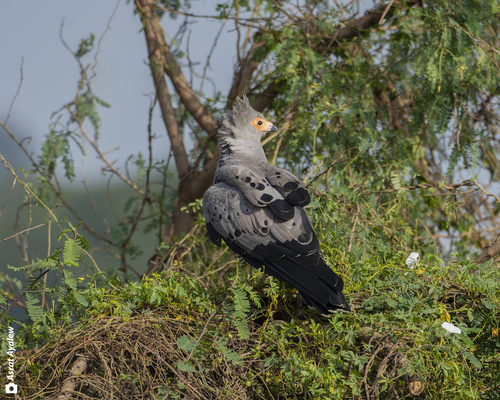
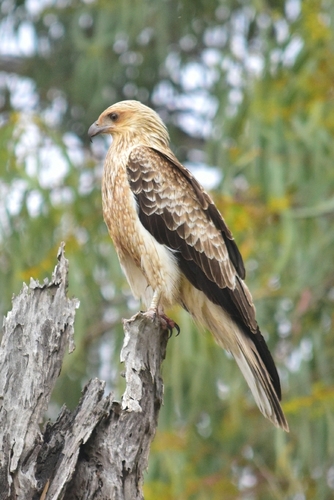
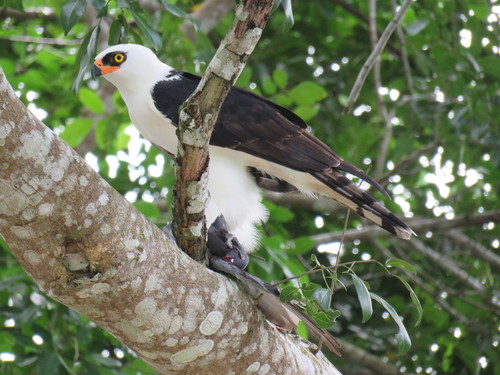
Scientific name: Spizaetus melanoleucus (Vieillot, 1816). As its common name suggests, this is a black-and-white eagle that resembles small typical eagles that are sometimes separated into the genus "Hieraaetus". It measures 20–24 inches (51–61 cm) in total length and weighs approximately 30 ounces (850 g). Its head, neck, and body are white; a small crest forms a black spot on the top of the head, and the area around the eyes, particularly toward the bill, is also black. The wings are black with a noticeable white leading edge, and the tail is brownish, barred with black and dark grey, and ends in a white tip. Adults have orange irises, while juveniles have greyish irises; the feet range from pale to bright yellow and have black talons. The bill is black with a yellow cere. The sexes share the same coloration, but females are larger than males. Immature birds have pale edges on their upper wing coverts and some brownish-grey feathers on the back. Within its range, the black-and-white hawk-eagle is rarely confused with other birds, the only exception being juvenile Grey-headed Kites, which are known to mimic multiple species of hawk-eagles. The black-faced hawk (Leucopternis melanops) has very similar overall coloration, but it is much smaller and has a black tail with a single bold white bar in the center. The ornate hawk-eagle (Spizaetus ornatus), presumed to be a very close relative of S. melanoleucus, looks quite similar when young. However, the wings, back, and tail of young S. ornatus are much lighter, and they do not have a black eye-ring. This species occurs from Oaxaca to Veracruz in southern Mexico, extending southward throughout Central America, absent from most of El Salvador and the Pacific coast of Nicaragua. In South America, it occurs on the Pacific side of the Andes as far south as Ecuador. The majority of its range runs along the Caribbean coast from northern Colombia and Venezuela to the Guianas, extending south through eastern Brazil, Paraguay, and Uruguay to northeastern Argentina, and westward from there to Beni and Santa Cruz in northeastern Bolivia. A population of black-and-white hawk-eagles also lives in the Loreto Region of northeastern Peru; it is unknown how far this population is isolated from the rest of the species' range. The species is absent from the western Amazon basin; while it is not common in lands east of the western Amazon (such as Minas Gerais), at least one nest has been described from the region. Its natural habitats are any type of lowland forest, though it does not prefer very dense, humid forest or savanna-like semiarid habitat. It does not tolerate habitat fragmentation very well; while it prefers diverse mixed forest and shrubland habitat, it requires large stands of closed-canopy forest to thrive. Its range does not extend far into uplands, but one individual was sighted at an altitude of around 4,000 ft (1,200 m) above sea level in Buena Vista Nature Reserve in Colombia's Sierra Nevada de Santa Marta. Another individual was sighted August 7, 2025 at an altitude of about 7,200 ft (2,200 m) ASL in the Bellavista Cloud Forest Reserve in Ecuador's Tandayapa Valley by birding guides Juan-Carlos Crespo and JT Birds. This carnivorous species feeds on mammals, toads, squamates, and particularly a wide variety of birds. Among bird prey, it is known to prefer tree-dwelling species such as oropendolas, aracaris, tanagers, and cotingas. But ground-dwelling and water birds including tinamous, chachalacas, wood quails, cormorants, and the highly threatened Brazilian merganser (Mergus octosetaceus) have also been recorded as prey. Black-and-white hawk-eagles have been known to attack small monkeys, though the intent of this behavior is not clear. To date, there are no recorded observations of the species actually killing and eating a monkey, and opossums are counted among its more significant mammalian prey. Its preferred hunting technique is to soar high until it spots suitable prey, then dive down onto it, usually directly into the forest canopy. However, it has also been observed launching from a perch to catch a white woodpecker (Melanerpes candidus) that had been mobbing it in mid-air. It prefers to hunt along ridges and forest edges, where it can access canopy-level prey from an oblique direction rather than only directly above, and where ground-dwelling prey is also more accessible. It nests in the forest canopy, building a stick nest high up in exposed trees on ridges and similar locations that offer a clear view of good hunting grounds. Detailed observations of its nesting habits are scarce. A nest was found and described by researchers in 2006 in southeastern Brazil, and in 2009 researchers found and studied two nests in Belize. In Panama, birds began constructing a nest in September, during a dry spell within the rainy season. The nesting attempt was abandoned when heavy rains resumed, which suggests the main nesting season may start before the onset of the rainy season. The limited existing data agrees with this timeline, and at least in Central America the nesting season appears to run from March to June or thereabouts. There is a general lack of information on the movements and population status of the black-and-white hawk-eagle. Each bird appears to require a hunting territory of at least around 3,500 acres (1,400 hectares). While the variety of habitat types it occupies suggests it is not particularly susceptible to changes in land use, it is still a rare and localized species almost everywhere in its range. Until 2000, the IUCN classified it as a Near Threatened species due to uncertainties about its status. Because no evidence of a marked population decline has been found and the species occurs across a wide range, it was downlisted to Least Concern.