About Spirodela polyrhiza (L.) Schleid.
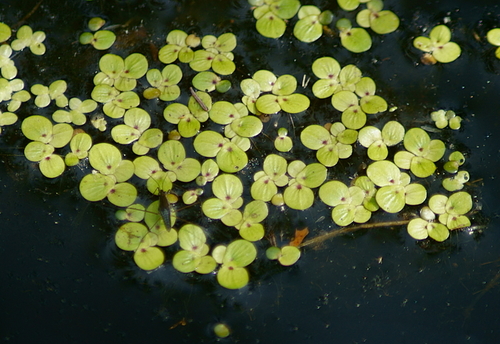
Spirodela polyrhiza (L.) Schleid. is a perennial aquatic plant that usually grows in dense colonies, forming a mat across the water surface. Each individual plant is a smooth, round, flat disc measuring 0.5 to 1.0 cm wide. Its upper surface is mostly green, sometimes red, while the lower surface is dark red. This species produces several minute roots, and a pouch that holds both male and female flowers. The top portion of the plant dies in fall, and the species often overwinters as a dormant structure called a turion. Turions sink to the bottom of the water body and remain dormant until water temperature reaches 15 °C, at which point they germinate on the bottom and begin a new life cycle. Because S. polyrhiza lives in ponds and slow-moving water bodies, it differs developmentally from terrestrial plants in both morphology and physiology. It undergoes primarily vegetative growth in spring and summer, producing new fronds, and it rarely flowers. In fall and winter, it enters a dormant phase as turions in response to nutrient starvation and freezing temperatures. Due to its fast growth, direct contact with its growing medium, and small genome size of approximately 150 Mb, S. polyrhiza is an ideal system for research and applications related to biofuels, bioremediation, and carbon cycling. A comprehensive genomic study of this species was published in February 2014, whose results provide insights into how the organism is adapted to rapid growth and an aquatic lifestyle. S. polyrhiza is distributed worldwide. It is found in North America, Asia, and Central Europe, and occurs more rarely in Central and South America. It grows in both tropical and temperate climates. It is not prevalent in New Zealand, and only occurs rarely in Australia. Large-scale cultivation of S. polyrhiza is carried out in outdoor water tanks, most often in association with wastewater treatment. Tanks are fed with wastewater, and the floating duckweed is harvested from the surface. Biomass grown in industrial wastewater treatment systems is further processed for use as biofuel, while biomass from agricultural wastewater treatment facilities is used as animal feed. S. polyrhiza is used for bioremediation, to remove toxic substances from aquatic environments and clean eutrophic waters, particularly in wastewater treatment plants. Its use as biofuel and animal feed is also growing in importance, and it is very rarely used for human nutrition.